.png)
catalyst for human potential
downtown seattle's home for personalized, integrative care: acupuncture, herbs, and functional medicine
Acid Reflux and GERD
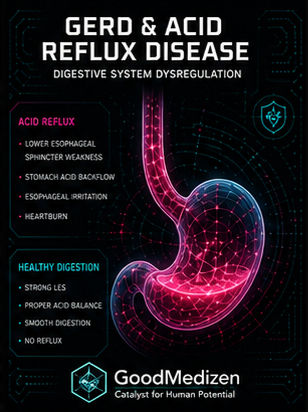
Reflux happens when the lower esophageal sphincter (LES) — a ring of muscle at the junction between the esophagus and stomach — fails to close properly.
Your Stomach Isn't the Enemy
For a condition this common, acid reflux is remarkably misunderstood.
If you've been dealing with heartburn, regurgitation, chest burning, a lump in your throat, or that awful acidic taste that creeps up at night, you've probably been handed a prescription for a proton pump inhibitor (PPI) — Prilosec, Nexium, Protonix, Prevacid. These drugs work by shutting down stomach acid production almost entirely. They're effective at reducing symptoms. They're also meant to be used for 4-8 weeks, not 4-8 years — which is how long many people end up on them.
In a significant number of reflux cases, the problem isn't that you have too much stomach acid. It's that you don't have enough.
What Reflux Actually Is
Reflux happens when the lower esophageal sphincter (LES) — a ring of muscle at the junction between the esophagus and stomach — fails to close properly. Stomach contents, which include acid, pepsin (a digestive enzyme), and sometimes bile, splash upward into the esophagus. The esophagus doesn't have the protective lining that the stomach does, so that contact causes burning, irritation, and over time, inflammation and tissue damage.
The LES is regulated by multiple signals. Stretch receptors in the stomach wall trigger it to close when the stomach is full. Hormonal signals — particularly cholecystokinin (CCK) and gastrin — modulate its tone. The vagus nerve, which runs from the brainstem to the gut, provides continuous autonomic input. Muscle tone in the diaphragm (which wraps around the LES) contributes to closure. Adequate stomach acid is actually part of what signals the LES to close — stomach acid drops, LES tone drops with it.
Conventional treatment focuses on one variable: the acid itself. Reducing acid doesn't fix why the sphincter is failing in the first place — and in many cases, low stomach acid is part of the actual problem.
The Low Acid Story
Stomach acid — hydrochloric acid, produced by parietal cells in the stomach lining — has several critical jobs. It denatures proteins so digestive enzymes can break them down. It activates pepsin, which requires an acidic environment to become functional. It sterilizes incoming food, killing off bacteria, fungi, and parasites before they can colonize the gut. It triggers the release of bile and pancreatic enzymes as food moves into the small intestine. And it signals the LES to close properly.
Stomach acid production declines naturally with age. It also drops with chronic stress (sympathetic nervous system dominance suppresses digestive function), H. pylori infection, autoimmune processes affecting parietal cells, certain nutrient deficiencies (zinc, B12, thiamine), and — ironically — long-term use of acid-suppressing medications, which can actually damage the cells that produce acid over time.
When stomach acid is low, food sits in the stomach longer because protein digestion is impaired. That extended residence time increases intra-abdominal pressure, which pushes against the LES from below. Fermentation increases — bacteria that should have been killed by acid instead multiply and produce gas. That gas pushes upward. The LES, which needs adequate acid signaling to maintain tone, relaxes. Stomach contents splash into the esophagus.
Long-term PPI use is associated with a cluster of downstream problems:
Nutrient deficiencies (B12, magnesium, iron, calcium). Stomach acid is required to cleave these nutrients from the proteins and minerals they're bound to in food. Without adequate acid, absorption drops — regardless of how much you're eating or supplementing.
Increased risk of C. difficile infection. Stomach acid's role as a first line of defense against ingested pathogens gets disabled. Bacteria that would normally be killed in the stomach instead reach the colon alive. C. difficile is especially opportunistic when the gut microbiome is already disrupted, and the resulting infection causes severe diarrhea that can be dangerous or life-threatening.
Small Intestinal Bacterial Overgrowth (SIBO). The stomach's acidity prevents bacteria from migrating upward from the colon into the small intestine — which should be relatively sterile. With acid suppressed, bacteria colonize where they don't belong, ferment the food passing through, and cause the bloating, gas, and food reactions that often drive patients back to their doctor for more digestive complaints.
Bone density loss. Calcium absorption is particularly acid-dependent. Long-term PPI use has been associated in multiple large studies with increased risk of hip, wrist, and spine fractures, particularly in postmenopausal women. Combine reduced calcium absorption with the magnesium depletion also seen with PPIs (magnesium is required for vitamin D activation and calcium regulation) and you have a recipe for accelerated bone loss.
This doesn't mean PPIs are always wrong. For true acid hypersecretion, ulcer disease, Barrett's esophagus, or severe erosive esophagitis, they're appropriate and often necessary. The assumption that every reflux case is a too-much-acid case is worth questioning — especially if PPIs haven't fully resolved your symptoms.
The Anxiety Connection
Some reflux cases don't present as heartburn at all. They present as anxiety, heart palpitations, shortness of breath, chest pressure, or panic attacks — symptoms that send people to cardiologists and psychiatrists before anyone checks the gut (if anyone ever does at all).
The vagus nerve innervates the stomach, heart, and lungs. It doesn't always give the brain specific information about which organ is sending a signal — it gives the brain a general alarm. When the stomach is distended, inflamed, or under pressure from reflux, the vagus nerve fires. The brain receives the signal but often misinterprets it as coming from the heart or lungs. Palpitations. Chest tightness. Shortness of breath. The nervous system, already on alert, starts escalating the response. Anxiety builds. The physical symptoms intensify. A feedback loop forms.
This is why some people with "anxiety disorder" actually have unresolved reflux. We see this regularly in clinic — patients who have been on anti-anxiety medications for years find their symptoms lift once we address what's happening in the gut.
Where TCM Comes In
Rebellious Stomach Qi — the clearest TCM description of reflux. Normal digestive energy moves downward; rebellious qi moves upward instead. Tracks with the vagal/motility dysfunction we see in reflux physiology — signals firing in the wrong direction.
Liver Qi Stagnation Invading the Stomach — reflux that flares with stress, emotional pressure, or before a period. Describes the stress-driven component that modern research frames as sympathetic nervous system suppression of digestive function.
Stomach Yin Deficiency — reflux with dryness, thirst, burning sensation, often worse at night. Corresponds closely with low stomach acid and insufficient mucus production.
Damp-Heat in the Middle Burner — reflux with bloating, heavy feeling after meals, bad breath, yellow tongue coating. Often associated with dysbiosis or H. pylori infection.
Identifying which pattern is driving your reflux changes the treatment. A rebellious qi pattern needs different support than a stomach yin deficiency pattern. Both might look like GERD on a conventional workup.
How We Approach It
Acupuncture regulates the vagus nerve — which controls both LES tone and the brain-gut alarm system. Specific points have been shown in research to improve gastric motility, reduce transient LES relaxations, and calm the sympathetic overdrive that suppresses digestive function. For reflux that presents with anxiety or palpitations, acupuncture addresses both layers simultaneously.
Chinese herbal medicine has some of the oldest and best-validated formulas in the world for digestive complaints. Worth noting specifically: berberine, a compound from traditional Chinese medicine, has been studied extensively for H. pylori eradication. A 2020 systematic review and meta-analysis of thirteen randomized controlled trials involving 2,111 patients found that adding berberine to standard triple therapy significantly improved H. pylori eradication rates, accelerated ulcer healing, relieved clinical symptoms, and reduced side effects (Wang et al., 2020). For patients who have failed conventional eradication protocols, or who want to avoid antibiotics, properly prescribed Chinese herbal medicine is a legitimate option with real evidence behind it.
Functional testing — At GoodMedizen, we use the GI-MAP (Gastrointestinal Microbial Assay Plus) by Diagnostic Solutions Laboratory. It uses quantitative PCR (qPCR) technology — significantly more sensitive than the culture-based or single-antigen tests used in most conventional gastroenterology workups. The GI-MAP can detect H. pylori at levels as low as 100 copies of DNA per gram of stool, along with eight specific virulence factors that indicate how aggressive a given strain is likely to be, and antibiotic resistance genes directly — so if treatment is needed, we know which antibiotics will actually work. We regularly find H. pylori on GI-MAP that was missed by prior conventional testing.
Lifestyle and nutritional support — specific, targeted interventions based on what's actually driving your pattern. Not the generic avoid spicy foods list.
When to Consider Us
Your PPI works but you don't want to be on it indefinitely
Your PPI doesn't fully resolve your symptoms, or symptoms return the moment you taper off
You've been told you have GERD but your endoscopy was clean
You have anxiety or heart palpitations that nobody can fully explain
Your reflux is worse with stress or tied to your menstrual cycle
You're bloated, belching, or feeling like food sits heavy — classic low-acid signs disguised as high-acid symptoms
You have other digestive complaints alongside the reflux — IBS, food sensitivities, SIBO
You want to understand what's actually driving the problem, not just suppress it
Selected References
Wang, Z., et al. (2020). The efficacy of berberine-containing quadruple therapy on H. pylori eradication. Frontiers in Pharmacology, 10, 1694.
Jiang, Y., et al. (2018). Berberine combined with triple therapy vs triple therapy for H. pylori eradication. ECAM, 2018, 8716910.
Jung, H. K., et al. (2014). Effect of acupuncture on gastroesophageal reflux disease. Neurogastroenterology & Motility.
Yang, Y. X., et al. (2006). Long-term PPI therapy and risk of hip fracture. JAMA, 296(24), 2947–2953.
Freedberg, D. E., et al. (2017). The risks and benefits of long-term use of PPIs. Gastroenterology, 152(4), 706–715.
Dickman, R., et al. (2007). Acupuncture vs. doubling the PPI dose in refractory heartburn. APT, 26(10), 1333–1344.
Diagnostic Solutions Laboratory. GI-MAP. diagnosticsolutionslab.com