.png)
catalyst for human potential
downtown seattle's home for personalized, integrative care: acupuncture, herbs, and functional medicine
Acne
At the cellular level, acne forms when four things happen in sequence. A hair follicle produces too much sebum (oil).
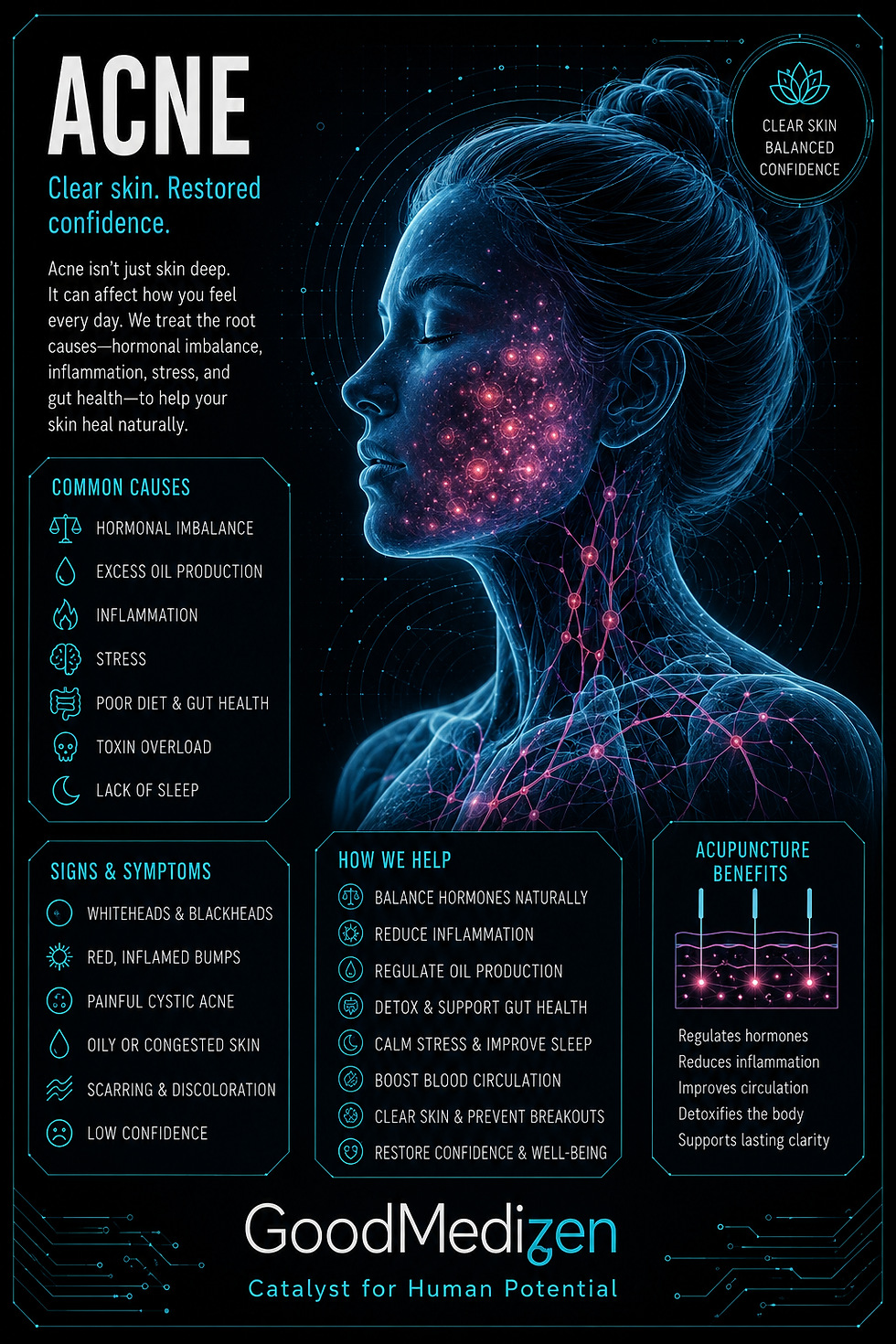
The Most Frustrating Part About Acne Isn't the Acne
It's the advice.
You've been told to wash your face more. You've been told to wash your face less. You've been handed a tube of benzoyl peroxide, a prescription for spironolactone, maybe a round of antibiotics, possibly Accutane. You've cut dairy. You've cut gluten. You've tried the seed cycling and the zinc and the tea tree oil and the expensive serum your cousin swears by. Maybe something worked for a while. Then it stopped. Or it worked on your forehead but now your jawline is a mess. Or your skin finally cleared and then you got off the pill and everything came roaring back.
Acne isn't a skin disease. Your skin is the screen where a deeper pattern is showing up — and treating the screen without addressing the signal is why most approaches stall out or only work for a while.
What Acne Actually Is
At the cellular level, acne forms when four things happen in sequence. A hair follicle produces too much sebum (oil). Dead skin cells fail to shed properly and clog the follicle. Bacteria — Cutibacterium acnes, formerly P. acnes — multiply inside that trapped, low-oxygen environment. The immune system detects the bacterial overgrowth and mounts an inflammatory response. That's the pimple.
Every step of that cascade is regulated by biological signals the body is receiving from somewhere else. The question that actually matters is: why is the body sending those signals in the first place?
Sebum production is controlled by androgens — primarily testosterone and its more potent derivative, DHT (dihydrotestosterone). Sebaceous glands have androgen receptors on their surface, and when DHT binds to those receptors, it activates a genetic program inside the sebocytes (the oil-producing cells of the gland). That program does two things: it triggers sebocyte proliferation — the gland physically grows — and it upregulates the enzymes that produce sebum lipids.
This program exists for good reason. Around puberty, the body needs to prepare skin for reproductive maturity. Sebum coats skin and hair with antimicrobial lipids, provides waterproofing, and carries pheromonal signaling. So when androgens rise and sebum production ramps up, the gland isn't malfunctioning. It's executing exactly the program it was built to execute.
The problem is that modern life keeps hitting that signal when the body isn't actually asking for it.
Why the Signal Keeps Firing
Puberty. The adrenals and gonads begin producing significantly higher levels of androgens. Sebaceous glands respond accordingly — gland enlargement, increased sebum — and the resulting skin changes are developmentally appropriate. Acne happens when this normal response hits a follicle environment that also has inefficient cell turnover or inflammation, and the setup for clogging is already there.
The week before a period. After ovulation, progesterone rises for about ten days and estrogen, which peaked around ovulation, begins to drop — reaching its lowest point in the final days before menstruation. Estrogen normally suppresses sebum production through multiple mechanisms: it raises SHBG (which binds testosterone and keeps it from reaching tissues), and it directly inhibits lipid synthesis inside sebocytes. When estrogen drops at the end of the luteal phase, both of those brakes release at the same time. Free testosterone increases and sebaceous lipid production ramps up. This creates the premenstrual breakout window.
Something else worth noting: progestins — the synthetic progesterone-like compounds used in hormonal birth control — complicate this picture further. Many older progestins (levonorgestrel and norgestrel, for example) have measurable androgenic activity — they can bind to androgen receptors and stimulate sebum production directly. This is why some women actually develop acne on certain birth control pills rather than improving. Newer progestins like drospirenone are anti-androgenic and often improve acne, which is part of why drospirenone-containing pills (Yaz, Yasmin) are sometimes prescribed specifically for acne. The specific progestin in a given formulation matters significantly — and it's worth knowing what you're taking.
Ovulation. A surge of luteinizing hormone from the pituitary triggers the ovary to release an egg — and to briefly produce extra testosterone as part of that process. That mid-cycle testosterone spike binds to sebaceous androgen receptors and bumps oil production upward for a few days, which is why some women break out specifically around ovulation rather than (or in addition to) the premenstrual window.
Chronic stress. Under sustained stress, the adrenals produce elevated cortisol. Cortisol increases sebum output directly through its own receptor pathways on sebocytes. It also drives insulin resistance, and elevated insulin stimulates the ovaries to produce more testosterone (this is the core mechanism in PCOS-related acne). Cortisol additionally suppresses the immune system's ability to resolve inflammation cleanly — so when pimples form, they stay inflamed longer and heal slower. Stressful seasons don't just coincide with breakouts; they create the biochemical environment that produces them.
Stopping hormonal birth control. Synthetic hormones in the pill suppress the body's own androgen production and raise a protein called SHBG (sex hormone binding globulin) that binds up free testosterone and keeps it from reaching tissues. When you stop the pill, synthetic hormones exit the system within days. SHBG drops. Your ovaries and adrenals, which have been on an extended vacation from producing androgens at normal levels, often overshoot when they resume. Free testosterone can spike significantly higher than baseline for three to six months before the system recalibrates. That recalibration period is where post-pill acne lives.
Perimenopause. Estrogen production from the ovaries becomes erratic and eventually declines. Androgen production from the adrenals and residual ovarian tissue often holds relatively steady. The ratio shifts — less estrogen available to oppose androgen signaling at the receptor level means skin that has been fine for decades can suddenly behave the way it did at sixteen. Same testosterone level, different ratio, different outcome.
Across all of these, the gland isn't broken. It's responding exactly as designed to the information it's being given. The information is just coming at the wrong time, in the wrong proportions, from the wrong sources.
The Other Roots We Find
Hormones are usually one of several drivers, not the only one.
Gut dysfunction. The gut and the skin are deeply connected — they share immune regulation, inflammatory pathways, and overlapping hormonal metabolism. When the intestinal lining becomes permeable (often from chronic inflammation, food sensitivities, repeated antibiotic use, or dysbiosis), bacterial cell wall fragments called lipopolysaccharides (LPS) can cross into the bloodstream. LPS is a potent activator of the innate immune system — once it's circulating, it triggers inflammatory cytokines (IL-1, IL-6, TNF-alpha) that can amplify inflammation anywhere in the body, including the skin. Gut healing is almost always part of acne treatment that actually holds.
Impaired estrogen clearance. The liver processes estrogen through a two-phase conjugation pathway, packaging it for excretion through bile into the gut. From there, it exits in stool. When liver function is sluggish or bile flow is stagnant, conjugated estrogen metabolites can be deconjugated by gut bacteria (specifically bacteria that produce an enzyme called beta-glucuronidase) and reabsorbed back into circulation. This creates functional estrogen excess — even when blood estrogen levels look normal — and contributes to cyclical, cystic acne patterns. (This is part of a bigger conversation about the three phases of liver detoxification — check out our detox eBook for the full deep dive.)
Blood sugar dysregulation. Spikes in blood glucose drive spikes in insulin. Insulin has two effects relevant to acne: it stimulates ovarian testosterone production directly, and it suppresses SHBG, which increases the amount of free (biologically active) testosterone circulating. High-glycemic diets — and chronic stress eating patterns — create a low-grade version of the hormonal environment seen in PCOS, even in people without PCOS.
Dietary dairy. Milk contains bioactive hormones and growth factors, including IGF-1 (insulin-like growth factor 1), which stimulates sebocyte proliferation through the same pathways as androgens. Studies have shown meaningful associations between dairy intake and acne severity, particularly with skim milk. This doesn't mean everyone with acne needs to cut dairy — but if acne is stubborn and dairy is a staple, it's worth investigating.
Where TCM Comes In
Chinese medicine has been treating skin conditions for a very long time — from the inside, not the tube. Classical TCM doesn't ask what's on the skin. It asks what internal pattern is expressing itself on the skin. The answer shapes the treatment.
Lung Heat — breakouts on the forehead, nose, and upper cheeks, often with oily skin and sinus or respiratory symptoms. Tracks with histamine and inflammatory mediator activity affecting both respiratory epithelium and dermal tissue.
Stomach Heat or Damp-Heat in the Middle — breakouts around the mouth, chin, and jawline, often with digestive symptoms. This is the gut-skin axis with a 2,000-year-old name on it.
Liver Qi Stagnation with Heat — cyclical breakouts tied to the menstrual cycle, usually with PMS, breast tenderness, irritability, and headaches. Corresponds to functional estrogen excess with impaired hepatic clearance.
Blood Heat or Blood Stasis — deep cystic acne, slow to heal, leaves marks. Seen in patients with chronic inflammation, circulatory issues, or long-standing hormonal imbalance.
Modern labs and functional testing give us more data than TCM practitioners had thousands of years ago. Combining that data with pattern recognition refined across centuries of clinical observation is how we end up with a treatment plan that addresses your specific version of this — not a generic protocol.
How We Approach It
We don't start by treating your face. We start by asking why your body is expressing inflammation on your skin in the first place.
Acupuncture reduces systemic inflammation through measurable effects on inflammatory cytokines, regulates the HPO axis (hypothalamic-pituitary-ovarian) that governs sex hormones, improves circulation and lymphatic drainage, and downregulates the sympathetic nervous system. Cortisol is a direct driver of sebum production and immune dysregulation, and a nervous system that can shift reliably out of fight-or-flight lowers cortisol. We also use specific point protocols for skin patterns and, for stubborn cystic lesions, sometimes direct local treatment around affected areas.
Chinese herbal medicine shines for skin conditions. Classical formulas for acne often include compounds that clear heat (anti-inflammatory action on cytokines and prostaglandins), move blood (improve circulation and reduce scarring), and drain damp (support lymphatic and digestive clearance).
Functional medicine fills in the rest. We often run labs to look at comprehensive hormones — not just estrogen and progesterone but DHEA, total and free testosterone, DHT, and the estrogen metabolites through their different pathways. We look at fasting insulin, inflammatory markers (hs-CRP, homocysteine), and sometimes a full stool analysis. We address nutrient gaps that matter for skin — zinc, vitamin A, omega-3s, B-vitamins — support liver and gallbladder function, and work on blood sugar stability.
What we don't do: put you on a 14-step skincare routine. Your skincare matters. It's the last 10% of the solution. The first 90% is inside.
When to Consider Us
You've tried the topicals, the prescriptions, and the elimination diets, and your skin is still not okay
Your acne is clearly cyclical or worsens with your period
You got off hormonal birth control and your skin lost its mind
You have PCOS or suspected PCOS
Your acne started or got worse after antibiotics, a gut infection, or a stressful life event
You're in perimenopause and breakouts have joined the list of uninvited guests
You're tired of treating your skin like the problem when you suspect it's a symptom
Selected References
Bowe, W. P., & Logan, A. C. (2011). Acne vulgaris, probiotics and the gut-brain-skin axis. Gut Pathogens, 3(1), 1.
Dréno, B., et al. (2018). Microbiome in healthy skin, update for dermatologists. JEADV, 32(6), 812–820.
Kucharska, A., et al. (2016). Significance of diet in treated and untreated acne vulgaris. Postepy Dermatol Alergol, 33(2), 81–86.
Smith, R. N., et al. (2007). A low-glycemic-load diet improves symptoms in acne vulgaris. Am J Clin Nutr, 86(1), 107–115.
Son, M. J., et al. (2019). Acupuncture for acne vulgaris: A systematic review. ECAM, 2019.
Melnik, B. C. (2015). Linking diet to acne metabolomics, inflammation, and comedogenesis. CCID, 8, 371–388.