.png)
catalyst for human potential
downtown seattle's home for personalized, integrative care: acupuncture, herbs, and functional medicine
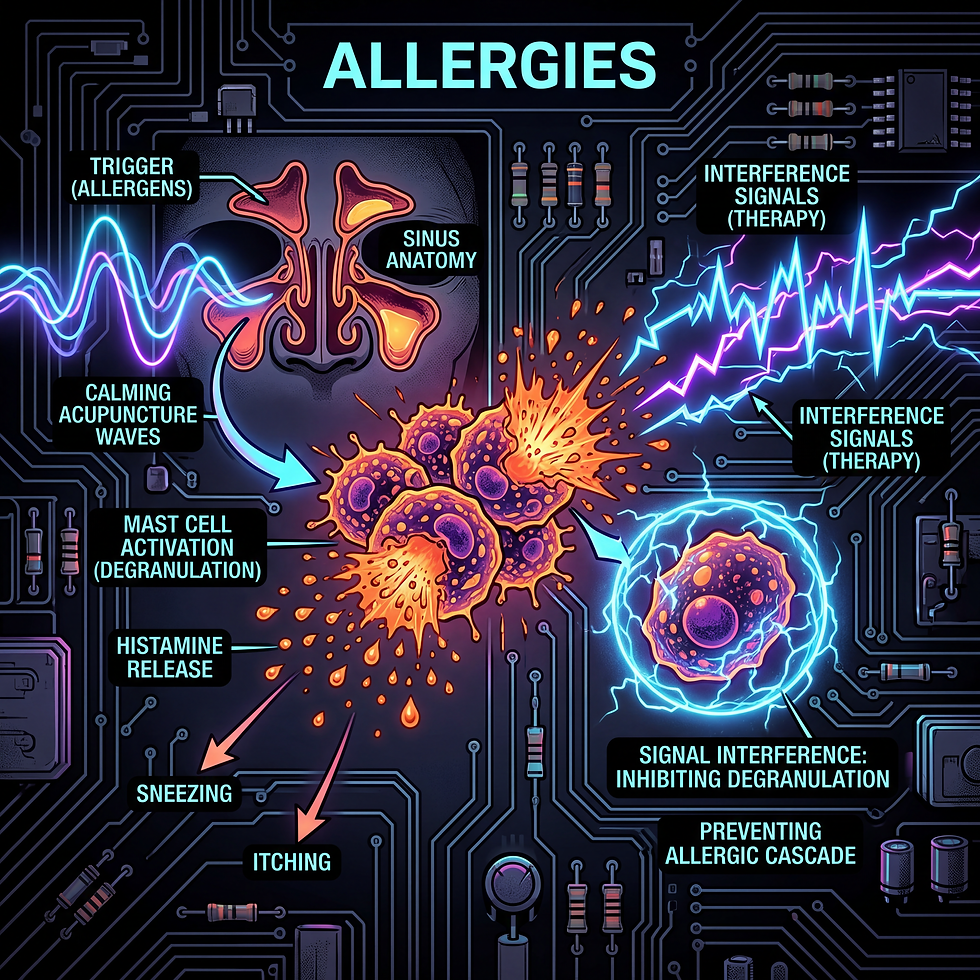
Allergies Are an Overcalibrated Immune Response, Not Just an Inconvenience
If you've been managing seasonal allergies, food sensitivities, or environmental reactivity with antihistamines and avoidance for years, you've probably accepted the model that allergies are just "how your body works" and the goal is symptom suppression. That model is incomplete. Allergies are an immune system that's making categorically different decisions than it should be making — reading harmless inputs as threats, generating inflammatory cascades against pollen, dander, food, or chemicals that shouldn't trigger them.
That overcalibration has identifiable drivers. Gut barrier integrity, microbiome composition, vitamin D status, methylation, histamine clearance capacity, hormonal patterns, stress regulation, and immune education all influence allergic reactivity. Antihistamines block the downstream signal — the work we're interested in is upstream.
What's Actually Happening in Allergic Reactions
The allergic response involves IgE antibodies binding to mast cells throughout the body — particularly in respiratory mucosa, gut, skin, and connective tissue. When the IgE encounters its specific antigen (pollen, dust mite, food protein), the mast cell degranulates, releasing histamine, leukotrienes, prostaglandins, tryptase, and inflammatory cytokines. These mediators produce the symptoms — vasodilation, mucus production, smooth muscle constriction, itching, swelling, and inflammation.
Several factors determine reactivity:
Gut barrier integrity. Intestinal permeability allows incompletely-digested food proteins and bacterial components into circulation, where they prime the immune system to react against them. The gut-allergy connection is direct.
Microbiome composition. Diversity and specific bacterial species shape immune education. Reduced diversity, depleted regulatory T-cell-supporting bacteria, and dysbiosis correlate with allergic reactivity.
Histamine handling. The body produces and metabolizes histamine constantly. DAO (diamine oxidase) in the gut breaks down dietary histamine; HNMT handles intracellular histamine. Genetic variants, gut dysfunction, and certain medications impair clearance — leaving more circulating histamine and lower symptom thresholds.
Vitamin D status. Vitamin D modulates immune function broadly. Deficiency correlates with increased allergic reactivity and worse asthma control.
Methylation status. Methylation handles histamine breakdown via HNMT. MTHFR variants and methylation bottlenecks contribute to histamine accumulation.
Mast cell activation. When mast cells are chronically activated (MCAS), the threshold for allergic-like reactions drops dramatically. MCAS overlaps with classical allergy but doesn't always show on standard allergy testing.
Cortisol patterns. Cortisol is anti-inflammatory; HPA axis dysregulation affects allergic response. Allergies often worsen during stress.
Hormonal influences. Estrogen amplifies histamine release; progesterone stabilizes mast cells. Allergies often worsen with cyclical estrogen peaks, in pregnancy, or in perimenopause.
Total allergic load. Symptoms appear when cumulative inputs exceed your threshold — often called the "bucket" model. Reducing any single input lowers the load below symptom threshold even when full elimination isn't possible.
Where TCM Comes In
Chinese medicine has frameworks for what it calls Wei Qi (defensive qi, roughly the immune surface) and the patterns underlying allergic presentations.
Lung Qi Deficiency with Wei Qi Deficiency. Frequent colds, allergies, easy chilling, fatigue, weak voice. The compromised immune surface pattern. Treatment tonifies lung qi and consolidates wei qi.
Wind-Cold or Wind-Heat invasion. The acute allergic flare patterns — sneezing, congestion, itchy eyes, sometimes hives. Wind-Cold is more cold/clear; Wind-Heat is more inflamed/colored. Treatment expels wind and addresses temperature.
Spleen Qi Deficiency with Damp. The chronic allergy pattern with mucus, sinus congestion, post-nasal drip, GI symptoms. Treatment tonifies the spleen and clears damp.
Kidney and Lung Qi Deficiency. Constitutional allergic tendency — long-standing seasonal allergies starting in childhood, often with asthma. Treatment tonifies kidney and lung.
Liver Qi Stagnation with Heat. Stress-driven allergy flares, irritability, headaches with allergic symptoms. Treatment soothes liver qi and clears heat.
How We Approach Allergies
Acupuncture has substantial evidence for allergic rhinitis. Multiple meta-analyses show reductions in symptom severity and medication use. The mechanism involves modulation of immune signaling, reduction of inflammatory cytokines, and TCM-pattern-specific effects. Both seasonal and perennial allergies respond.
Chinese herbal medicine for the specific TCM pattern. Several formulas have direct evidence for allergic rhinitis and asthma. Selection depends on the pattern.
Functional medicine workup. Comprehensive testing where clinically indicated: gut function evaluation (often the most important target), DAO and histamine markers in suspected histamine intolerance, methylation panel, vitamin D, omega-3 index, MCAS markers when symptoms suggest, food sensitivity testing in select cases.
Address the gut. Often the highest-leverage intervention. Comprehensive stool testing, addressing dysbiosis, repairing gut barrier, identifying and removing food triggers driving immune reactivity. The 5R framework (remove, replace, reinoculate, repair, rebalance) applies.
Histamine support. Quercetin (mast cell stabilizer with antioxidant properties), vitamin C (high-dose for histamine breakdown support), DAO supplements when DAO deficiency drives food-related histamine reactions, low-histamine diet in select patients short-term.
Targeted nutritional support. Vitamin D to optimal levels, methylated B-complex, magnesium, omega-3s, zinc, sometimes specific botanical support (butterbur for hay fever, stinging nettle, perilla).
Mast cell support when MCAS is part of the picture. H1 and H2 antihistamines if not already in use, mast cell stabilizers, identifying and reducing triggers.
Address co-conditions. Hashimoto's, hormonal patterns, stress, mold exposure — each contributes to allergic reactivity in different patients.
Lifestyle integration. HEPA filtration, dust mite covers, avoiding peak pollen times, neti pot or saline rinse, addressing indoor air quality, removing fragranced products.
When to Consider Us
- You have seasonal allergies that aren't well-controlled with standard antihistamines
- You want to reduce reliance on long-term antihistamine use
- You have allergic rhinitis with significant fatigue or systemic symptoms
- You suspect histamine intolerance or have multiple food sensitivities
- You have allergies alongside other immune patterns (autoimmune, frequent infections)
- You have allergies with prominent gut symptoms suggesting a connection
- You suspect MCAS and want comprehensive evaluation
- You're managing allergies during pregnancy or postpartum and want non-pharmaceutical options
- You have new-onset allergies in adulthood
Selected References
- Brinkhaus, B., et al. (2013). Acupuncture in patients with seasonal allergic rhinitis: A randomized trial. Ann Intern Med, 158(4), 225–234.
- McDonald, J. L., et al. (2013). Effect of acupuncture on house dust mite specific IgE, substance P, and symptoms in persistent allergic rhinitis. Ann Allergy Asthma Immunol, 111(6), 539–546.
- Maintz, L., & Novak, N. (2007). Histamine and histamine intolerance. Am J Clin Nutr, 85(5), 1185–1196.
- Mlcek, J., et al. (2016). Quercetin and its anti-allergic immune response. Molecules, 21(5), 623.
- Sicherer, S. H., & Sampson, H. A. (2018). Food allergy: A review and update on epidemiology, pathogenesis, diagnosis, prevention, and management. J Allergy Clin Immunol, 141(1), 41–58.
- Pfefferle, P. I., et al. (2021). The hygiene hypothesis — learning from but not living in the past. Front Immunol, 12, 635935.