.png)
catalyst for human potential
downtown seattle's home for personalized, integrative care: acupuncture, herbs, and functional medicine
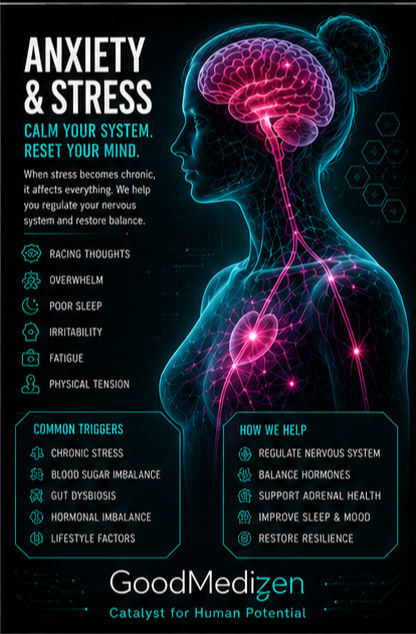
Anxiety Is a Body State Before It's a Mind State
If you've been told your anxiety is something you need to medicate, manage with cognitive techniques, or just learn to live with — you've gotten partial advice. Those approaches help, sometimes substantially. What they often miss is that anxiety has a physiological underlay that can be measured and addressed: autonomic nervous system patterning, neurotransmitter balance, hormonal status, gut-brain signaling, inflammation, blood sugar stability, and sleep architecture. People often try therapy and medication for years before discovering that addressing the physiological substrate makes the rest of the work much more effective.
That doesn't mean anxiety is purely physiological. Real life situations produce real anxiety, trauma leaves real patterns, and emotional and existential dimensions of anxiety deserve real attention. The case we're making is that the body and mind aren't separate systems — work on both, and what was stuck moves.
What's Actually Happening in Anxiety
Autonomic nervous system imbalance. The autonomic nervous system has two main branches — sympathetic (activation, mobilization, the "fight-or-flight" state) and parasympathetic (recovery, social engagement, the "rest-and-digest" state). In healthy regulation, these shift fluidly based on what the situation calls for. In chronic anxiety, the system is biased toward sympathetic activation, with reduced parasympathetic capacity. Heart rate variability (a measure of autonomic flexibility) is reduced.
HPA axis dysregulation. Cortisol patterns shift — elevated where it shouldn't be, low where it should be high, flattened diurnal curves. The result is the "wired and tired" pattern: anxiety alongside exhaustion, inability to wind down at night, inability to wake up in the morning.
Neurotransmitter dynamics. Serotonin, GABA, glutamate, norepinephrine, and dopamine all participate in mood and anxiety regulation. Imbalances in any of these — driven by genetic factors, nutritional status (B vitamins, magnesium, amino acid availability), inflammation, gut microbiome, or chronic stress — produce different anxiety patterns. Low GABA correlates with hypervigilance and physical tension. Glutamate excess correlates with racing thoughts and insomnia. Serotonin patterns affect rumination and mood.
Gut-brain signaling. About 90% of serotonin is produced in the gut. Gut microbiome composition affects mood, anxiety, and stress resilience through multiple pathways — vagal signaling, neurotransmitter production, immune signaling, and short-chain fatty acid production. Dysbiosis is increasingly linked to anxiety disorders.
Inflammation. Neuroinflammation drives anxiety in measurable ways. Elevated inflammatory cytokines (IL-6, TNF-alpha) cross the blood-brain barrier and affect neurotransmitter production, microglial activation, and mood circuits. Chronic systemic inflammation maintains a state of physiological threat-vigilance.
Blood sugar instability. Reactive hypoglycemia produces adrenaline release that mimics or triggers panic. Patients with significant blood sugar swings often have anxiety patterns that improve dramatically with stable eating patterns alone.
Hormonal contributors. Estrogen-progesterone fluctuations, thyroid dysfunction (especially subclinical hyperthyroidism), perimenopausal hormonal shifts, postpartum hormone changes, and disrupted cortisol patterns all drive anxiety. Anxiety that's clearly cyclical or hormonally timed needs hormonal evaluation.
Sleep disruption. Sleep deprivation directly impairs prefrontal cortex regulation of the amygdala (the brain's threat detection system). One night of poor sleep increases anxiety reactivity measurably. Chronic sleep dysfunction sustains anxiety regardless of other interventions.
Trauma physiology. Past trauma produces measurable nervous system patterning that affects current anxiety — hypervigilance, difficulty trusting safety signals, somatic tension, dissociation. Trauma work is often essential alongside physiological support.
Where TCM Comes In
Chinese medicine has been working with what it calls Shen disturbances (disturbances of the spirit-mind) for thousands of years. The frameworks fit clinical anxiety patterns in useful ways.
Heart Yin Deficiency with Empty Heat. Anxiety with palpitations, restlessness, insomnia (especially trouble falling asleep), night sweats, dry mouth. The wired-and-depleted pattern. Treatment nourishes heart yin and clears empty heat.
Heart Blood Deficiency. Anxiety with poor sleep, vivid dreams, palpitations, pallor, fatigue, sometimes brain fog. Treatment nourishes heart blood.
Heart-Spleen Deficiency. Anxiety with overthinking, exhaustion, poor sleep, digestive issues, worry-driven rumination. Treatment tonifies both.
Liver Qi Stagnation. Stress-driven anxiety, irritability, sighing, chest tightness, PMS, headaches, sometimes anger. The pressure-cooker pattern. Treatment soothes liver qi.
Liver Qi Stagnation transforming to Heat. Same underlying stagnation, now with prominent heat — irritability, red face, insomnia, headaches. Treatment soothes liver and clears heat.
Phlegm-Fire Harassing the Heart. Sudden severe anxiety or panic, chest oppression, restlessness, sometimes manic-quality energy. Treatment clears heat and transforms phlegm.
Kidney Yin Deficiency. Anxiety with deep exhaustion, hot flashes, dry mouth, low back weakness. Common in perimenopausal anxiety and post-burnout pictures. Treatment nourishes kidney yin.
How We Approach Anxiety
Anxiety care is layered. We work alongside therapy, psychiatric medication when appropriate, and other support — we don't replace those. What we add is the physiological work that often makes everything else more effective.
Acupuncture directly modulates the autonomic nervous system, increasing parasympathetic tone and reducing sympathetic dominance. Multiple meta-analyses show acupuncture effective for generalized anxiety, with effect sizes comparable to SSRI medications in some studies. Specific point protocols address the TCM pattern alongside the autonomic work.
Chinese herbal medicine for the specific TCM pattern. Pattern-matched formulas (Suan Zao Ren Tang for heart yin/blood patterns, Xiao Yao San for liver qi stagnation, Gan Mai Da Zao Tang for emotional dysregulation, and many others) have research support and consistent clinical effect.
Functional medicine workup. Comprehensive testing: methylation status (MTHFR, B12, folate, B6), red blood cell magnesium, full thyroid panel, fasting insulin and HbA1c, vitamin D, omega-3 index, inflammatory markers, organic acids when neurotransmitter imbalance is suspected, hormone panels for cyclical or perimenopausal anxiety, gut function evaluation when GI symptoms coexist.
Targeted nutritional support. Magnesium glycinate or threonate at therapeutic doses, methylated B-complex (especially methylfolate and methylcobalamin), L-theanine, glycine, taurine, sometimes targeted amino acid support based on neurotransmitter patterns. Adaptogens like ashwagandha, rhodiola, or holy basil based on pattern — ashwagandha specifically has strong evidence for anxiety reduction.
Blood sugar stability. Often dramatically helpful. Adequate protein at each meal, avoiding long fasts, reducing reactive carbohydrate spikes. For some patients this single intervention substantially reduces anxiety.
Sleep optimization. Non-negotiable. We address whatever's disrupting sleep — cortisol patterns, hormonal patterns, environmental factors, behavioral factors.
Vagal tone training. Slow paced breathing (specifically 5-6 breaths per minute), cold exposure (face splash with cold water activates the dive reflex), humming, gargling, and gentle movement all increase parasympathetic capacity. Training matters — the system gets better at regulating with practice.
Coordination of care. When trauma work is part of the picture, we coordinate with therapists familiar with somatic and trauma-informed approaches (EMDR, Somatic Experiencing, Internal Family Systems). When medication is part of the picture, we work alongside psychiatric prescribers — we don't recommend stopping medications without that physician's involvement.
When to Consider Us
- You've tried therapy and medication and want to add the physiological layer
- You have anxiety with prominent physical symptoms (palpitations, GI symptoms, tension)
- You have anxiety alongside hormonal patterns — cyclical, perimenopausal, postpartum
- You have anxiety alongside thyroid issues
- You have panic episodes that fit reactive hypoglycemia patterns
- You have anxiety with significant sleep disruption
- You suspect underlying inflammation, gut dysfunction, or methylation issues are contributing
- You want to reduce reliance on benzodiazepines or other anxiolytic medications (in coordination with prescriber)
- You have post-traumatic anxiety patterns and want somatic and integrative support alongside trauma work
Selected References
- Pilkington, K., et al. (2007). Acupuncture for anxiety and anxiety disorders — a systematic literature review. Acupunct Med, 25(1–2), 1–10.
- Errington-Evans, N. (2012). Acupuncture for anxiety. CNS Neurosci Ther, 18(4), 277–284.
- Lopresti, A. L., et al. (2019). An investigation into the stress-relieving and pharmacological actions of an ashwagandha (Withania somnifera) extract. Medicine (Baltimore), 98(37), e17186.
- Boyle, N. B., et al. (2017). The effects of magnesium supplementation on subjective anxiety and stress. Nutrients, 9(5), 429.
- Cryan, J. F., et al. (2019). The microbiota-gut-brain axis. Physiol Rev, 99(4), 1877–2013.
- Porges, S. W. (2011). The Polyvagal Theory: Neurophysiological Foundations of Emotions, Attachment, Communication, and Self-Regulation. W. W. Norton & Company.