.png)
catalyst for human potential
downtown seattle's home for personalized, integrative care: acupuncture, herbs, and functional medicine
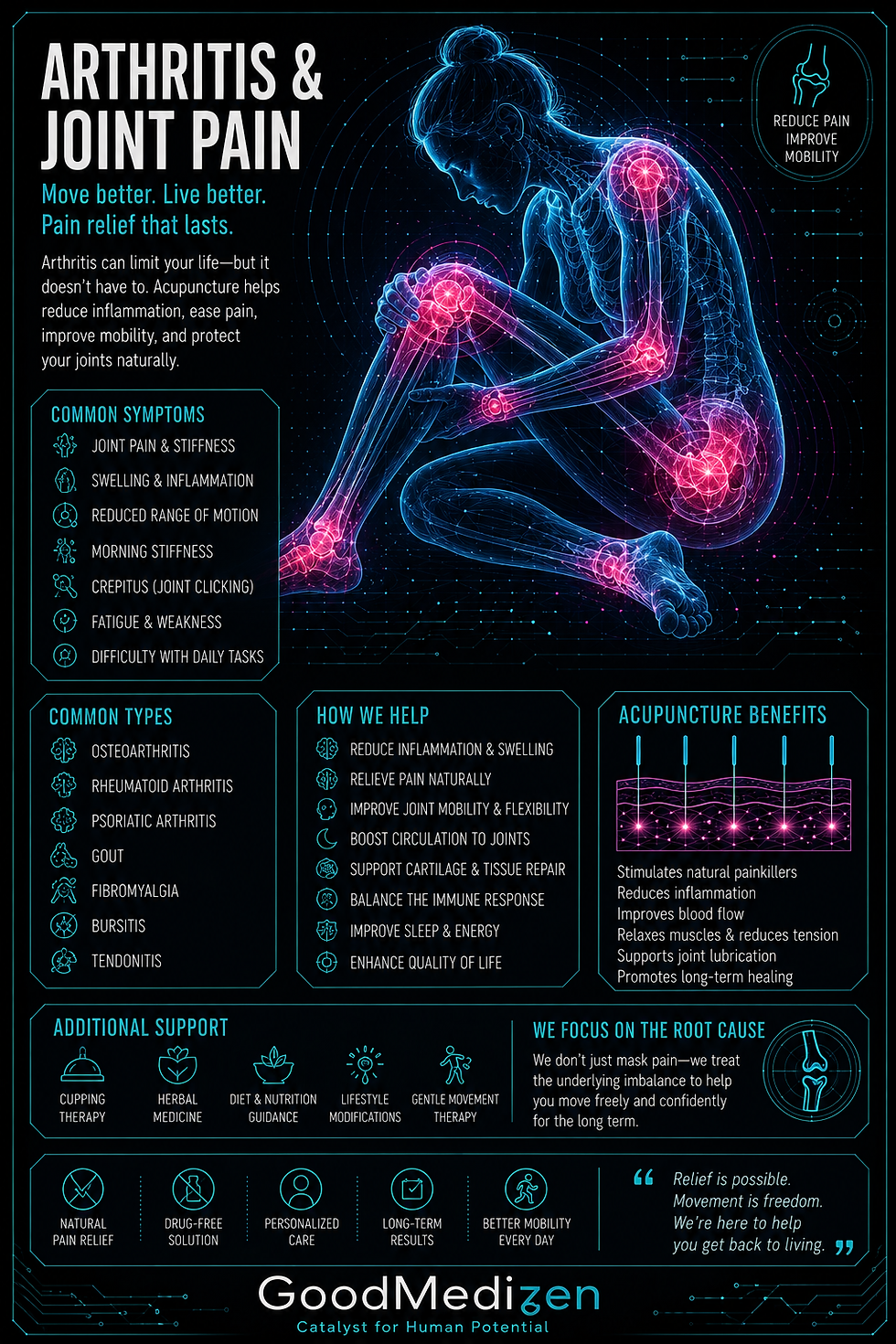
Arthritis Is Not Just Wear and Tear
That's the oldest and most persistent misconception about joint pain. The "wear and tear" framing suggests that cartilage is like brake pads — you use it up with time and activity, and eventually you need surgery. It's a convenient story, but it doesn't hold up to the actual biology.
Cartilage is living tissue. It's maintained by cells called chondrocytes that continuously break down and rebuild the extracellular matrix in response to the mechanical and chemical environment around them. When that environment stays favorable — adequate loading, low inflammation, sufficient nutrients — cartilage can maintain itself remarkably well into old age. When the environment turns hostile — chronic inflammation, metabolic dysfunction, repetitive asymmetric loading, poor nutrient status — the chondrocytes shift into catabolic mode, breaking cartilage down faster than they rebuild it.
Which means "arthritis" isn't primarily a mechanical problem you can't fix. It's an inflammatory and metabolic problem you often can — at least up to the point of significant structural change. Even when the structural changes are established, reducing the ongoing inflammation can meaningfully reduce pain and slow progression.
What's Actually Happening in an Arthritic Joint
Healthy joints have four components working together: cartilage (the shock-absorbing lining on the ends of bones), synovial fluid (the lubricant), the synovial membrane (which produces the fluid and regulates the joint environment), and the surrounding ligaments and muscles that stabilize the joint.
In osteoarthritis — the most common type — the sequence typically goes: mechanical or inflammatory insult triggers chondrocytes to release inflammatory cytokines (IL-1, IL-6, TNF-alpha). These cytokines activate enzymes called matrix metalloproteinases (MMPs) that break down cartilage faster than it's being rebuilt. The synovial membrane, sensing the breakdown products, becomes inflamed and produces more cytokines, amplifying the cycle. The underlying bone responds to the loss of cartilage protection by thickening and forming bone spurs (osteophytes). Surrounding muscles guard the joint to protect it, developing trigger points and restricting motion. What started as a localized cartilage issue becomes a whole-joint inflammatory pattern with structural consequences.
What triggers that cascade varies. Sometimes it's obvious mechanical injury. Sometimes it's asymmetric loading from a movement pattern you've developed. Often it's systemic inflammation from gut dysbiosis, metabolic dysfunction, elevated blood sugar, or chronic stress — conditions that flood the whole body with inflammatory signaling, with joints being particularly vulnerable tissue.
Rheumatoid arthritis, psoriatic arthritis, and ankylosing spondylitis are autoimmune arthropathies — conditions where the immune system misidentifies joint tissue as foreign and attacks it directly. The joint-level presentation is similar (inflammation, cartilage erosion, pain, dysfunction), but the root cause is immune dysregulation rather than mechanical or metabolic stress. Addressing these conditions requires addressing the underlying immune pattern — which is covered more thoroughly on our Autoimmune Conditions page.
Gout and pseudogout are crystalline arthropathies — conditions where crystals (uric acid in gout, calcium pyrophosphate in pseudogout) deposit in joint tissue and trigger acute inflammatory attacks. These have their own specific metabolic drivers and respond to different interventions than typical OA or RA.
What Drives Chronic Joint Inflammation
Metabolic dysfunction. Insulin resistance, elevated blood sugar, and visceral adiposity all drive systemic inflammation that concentrates in joint tissue. This is part of why arthritis severity correlates more strongly with metabolic health than with joint age. Improving metabolic markers often reduces joint pain independent of any direct joint treatment.
Gut permeability and dysbiosis. An inflamed, leaky gut allows bacterial fragments (lipopolysaccharides) into the bloodstream where they activate immune cells throughout the body. The joints are particularly sensitive to this systemic immune activation. Gut healing is often a core component of lasting joint pain reduction.
Dietary drivers. High-glycemic diets, processed seed oils, and food sensitivities all contribute to systemic inflammation. Omega-3 fatty acid deficiency shifts the inflammatory balance toward pro-inflammatory prostaglandins. Refined sugar directly drives chondrocyte dysfunction.
Nutrient deficiencies that matter for joints. Vitamin D supports cartilage health and modulates inflammatory response. Vitamin K2 directs calcium away from soft tissues (where it doesn't belong) into bone (where it does). Magnesium is required for hundreds of enzymatic reactions including those involved in inflammatory regulation. Collagen synthesis requires vitamin C and bioavailable protein.
Asymmetric and compensatory loading. A long-standing movement dysfunction — a leg length difference, an old ankle injury that changed your gait, a chronic hip tightness — loads specific joints more than others. Over years, that excess load accelerates cartilage breakdown in the overloaded joint. Fixing the joint alone without addressing the movement pattern loses to it eventually.
Chronic stress. Cortisol is both anti-inflammatory (short-term) and pro-inflammatory (chronic). Chronic HPA axis activation combined with low HRV and poor sleep creates an internal environment that flares almost any inflammatory condition, including arthritis.
Where TCM Comes In
Chinese medicine describes arthritis through the framework of Bi syndrome — "painful obstruction" — which has been categorized in classical texts for at least two thousand years. The differentiation is precise and clinically useful.
Wind Bi — pain that moves from joint to joint, changes location, appears suddenly. Corresponds to early inflammatory presentations before a pattern is established.
Cold Bi — severe, fixed, localized pain that's worse in cold weather and better with heat. Corresponds to inflammatory patterns where impaired circulation and muscle guarding amplify pain.
Damp Bi — heavy, achy, swollen joints that feel worse in humidity or with weather changes. Corresponds to joint effusion, edema, and the chronic low-grade inflammation of many OA presentations.
Heat Bi — red, hot, swollen, severely painful joints. Corresponds to acute autoimmune flares and gouty attacks.
Bone Bi — deep, chronic pain with joint deformation and limited motion. Corresponds to advanced degenerative changes where structural alteration has become part of the picture.
Kidney Deficiency underlies many chronic Bi patterns. The Kidneys in TCM govern the bones, and chronic joint degeneration is often partly a deep constitutional pattern — which means treatment has to include constitutional support, not just local joint work.
The TCM pattern tells us whether we need to warm or clear heat, move or nourish, tonify or drain — which shapes acupuncture point selection, herbal prescribing, and the kinds of modalities we layer in.
How We Treat Arthritis at GoodMedizen
At GoodMedizen, we treat musculoskeletal conditions using our proprietary system — Tissue Response Assessment and Corrective Strategy, or TRACS. This approach integrates the needling of myofascial trigger points with careful attention to timing, sequence, and related structures to create a comprehensive treatment protocol that delivers more effective and longer-lasting results than standard acupuncture protocols alone.
For arthritis specifically, this matters because the affected joint is rarely the only problem. The muscles around an arthritic knee develop trigger points that restrict motion and amplify pain. The hip above and ankle below shift their mechanics to protect the knee, creating compensation patterns that load other joints asymmetrically. Treatment that only addresses the painful joint misses the whole compensation chain that's perpetuating the problem.
Alongside TRACS, we use:
Traditional acupuncture reduces local inflammation, improves circulation to ischemic joint tissue, and engages the body's endogenous pain-modulation system. For acute flares, acupuncture provides meaningful in-session relief. For chronic arthritis, regular treatment reduces baseline pain and often slows progression.
Electroacupuncture adds low-frequency current to needles at specific points. For deep joints like the hip and for muscular components around affected joints, this enhances the analgesic and circulatory effects.
Point Injection Therapy (PIT) is one of our most valuable tools for arthritis. Rather than pharmaceutical cortisone — which reduces inflammation short-term but accelerates cartilage damage with repeated use — we inject compounds that support tissue health. Our injectable toolkit includes:
- Homeopathic Zeel — plant extracts that stimulate growth factor release, protect cartilage, and promote tissue regeneration; particularly well-studied for osteoarthritis with trials showing comparable pain relief to NSAIDs without the GI and cardiovascular side effects
- Homeopathic Traumeel — botanical anti-inflammatory with comparable effectiveness to NSAIDs for reducing pain and swelling, significantly better safety profile (Schneider, 2011)
- Spascupreel — for the muscle spasm and guarding that accompanies arthritic joints
- Procaine and Lidocaine — local anesthetics that can deactivate the trigger points driving joint guarding
- Methylcobalamin and Hydroxocobalamin (B12) — for patients with associated nerve involvement
- Sarapin — FDA-approved botanical compound with a 70+ year history in pain medicine
Peptide therapy for patients with significant joint damage or slow-healing tissue. BPC-157 and TB-500 have emerging research supporting tissue repair, and can be particularly useful for post-injury joints and tendon/ligament involvement around arthritic joints.
Cupping, gua sha, and moxibustion for fascial restrictions around affected joints and (with moxibustion) targeted warming for cold-pattern presentations.
Chinese herbal medicine tailored to the Bi pattern. Formulas for cold-pattern Bi (warming, circulating), damp-pattern Bi (draining, diuretic), heat-pattern Bi (clearing, cooling), and chronic kidney-deficient Bi (tonifying, strengthening) form the framework, modified for the individual presentation.
Functional medicine. We assess metabolic health (fasting insulin, HbA1c, hs-CRP), vitamin D status, omega-3 index, and where relevant, gut microbiome and food sensitivity testing. We use this to build a targeted anti-inflammatory plan with nutritional interventions backed by evidence rather than scattershot supplementation.
Targeted nutraceuticals with real evidence. Curcumin (with absorption enhancement like BCM-95 or phospholipid complexes) has multiple RCTs supporting its effectiveness in osteoarthritis. Boswellia serrata reduces inflammatory mediators and joint pain in both OA and RA trials. High-dose omega-3 fatty acids reduce systemic and joint-level inflammation. Glucosamine and chondroitin have mixed evidence but can be worth trying for some patterns. Collagen peptides support cartilage building blocks. We prescribe based on evidence and your specific picture, not as a blanket.
Lifestyle integration. Joint-sparing strength training (non-optional for maintaining joint health as we age), anti-inflammatory nutrition, sleep optimization, and stress regulation all get addressed. The joint can't stay well if the systemic environment doesn't support it.
When to Consider Us
- You've been diagnosed with arthritis and want options beyond NSAIDs and steroid injections
- Your NSAIDs are causing stomach problems or you've been told to reduce them
- You're considering joint replacement and want to see if integrative treatment can delay or avoid it
- You have arthritis alongside other inflammatory conditions (IBD, autoimmune disease, metabolic syndrome)
- Your arthritis clearly flares with stress, diet, or weather changes
- You want to understand what's driving the inflammation in the first place
- You've had joint replacement surgery and want to optimize recovery and protect the remaining joints
- You have early-stage arthritis and want to slow or reverse progression
Selected References
- Manheimer, E., et al. (2010). Acupuncture for peripheral joint osteoarthritis. Cochrane Database Syst Rev, (1), CD001977.
- Corbett, M. S., et al. (2013). Acupuncture and other physical treatments for the relief of pain due to osteoarthritis of the knee: Network meta-analysis. Osteoarthritis Cartilage, 21(9), 1290–1298.
- Schneider, C. (2011). Traumeel: An emerging option to NSAIDs in acute musculoskeletal injuries. PMC 3085232.
- Birnesser, H., et al. (2004). The homeopathic preparation Zeel comp N compared to hyaluronic acid for knee osteoarthritis. J Musculoskelet Res, 8(2-3), 119–128.
- Daily, J. W., et al. (2016). Efficacy of turmeric extracts and curcumin for alleviating the symptoms of joint arthritis: A systematic review and meta-analysis. J Med Food, 19(8), 717–729.
- Sengupta, K., et al. (2010). A double blind, randomized, placebo controlled study of the efficacy and safety of 5-Loxin for treatment of osteoarthritis of the knee. Arthritis Res Ther, 10(4), R85.