.png)
catalyst for human potential
downtown seattle's home for personalized, integrative care: acupuncture, herbs, and functional medicine
The Problem With How Back and Neck Pain Usually Gets Treated
You've probably been through the standard sequence. Over-the-counter anti-inflammatories. A muscle relaxer that knocked you out but didn't actually fix the pain. A round of physical therapy that helped for a while, then plateaued. Maybe a cortisone injection. Maybe an MRI that turned up "multilevel degenerative changes" or "disc bulges consistent with your age" — language that manages to sound both damning and dismissive at the same time. Possibly a referral to a surgeon who told you your imaging doesn't actually explain your symptoms.
Meanwhile you're the one still wincing when you reach for the coffee filter, still avoiding the commute, still sleeping in the weird half-upright position that might hurt less depending on the night.
The standard model treats back and neck pain as a structural problem. Sometimes it is. More often, it's a problem of interacting systems — nerves, muscles, fascia, joints, discs, and the nervous system that's supposed to be coordinating all of it — where the actual pain generator isn't where the pain is, and single-layer treatment can only produce single-layer results.
What's Actually Going On in Your Back and Neck
The spine is an engineering compromise. Twenty-four stacked vertebrae protect the spinal cord while still allowing you to bend, twist, and rotate. Between each pair of vertebrae sit a disc (shock absorber), two facet joints (guiding rails), and a nerve root exiting through a small foramen. Surrounding all of this is a complex envelope of ligaments, deep stabilizer muscles (multifidus, rotatores, deep cervical flexors), larger prime movers (erector spinae, traps, latissimus), and continuous sheets of fascia connecting everything.
When any one of these structures fails, gets irritated, or starts firing incorrectly, it affects the others. A single acute muscle strain can alter the way you move for weeks afterward, which changes the load on a facet joint, which becomes inflamed, which reflexively tightens nearby muscles, which develops trigger points, which refer pain into new territory. Six weeks later the original injury is healed and you still hurt — but now for different reasons than you started.
This is why chronic back and neck pain rarely has a single clean diagnosis. It's usually a layered problem that's been building on itself, and treatment that targets only one layer produces only partial results.
Why Imaging Often Doesn't Tell the Whole Story
MRI shows tissue structure. It doesn't show pain generation. The two are correlated but not identical.
Studies looking at MRIs of asymptomatic adults — people with no back pain at all — have consistently found high rates of disc bulges, degenerative changes, and facet arthritis. By age 40, more than half of people with no pain show "abnormal" findings on MRI. By 60, almost everyone does. These findings are often normal age-related changes, not pain sources.
The reverse is also true. People with debilitating pain often have clean imaging. This is because the pain generators that actually drive most chronic back and neck pain — myofascial trigger points, fascial restrictions, joint dysfunction, sustained muscle hypertonicity, nerve sensitization — aren't visible on MRI. They require hands-on evaluation and careful movement assessment to identify.
The practical consequence: imaging findings should inform treatment but not dictate it. A disc bulge at L4-L5 might be contributing to your pain, or it might just be there. A clean MRI doesn't mean there's nothing wrong. The evaluation has to go further than the scan.
The Pain Generators We Actually Find
Myofascial trigger points. Small, hyperirritable knots in muscle tissue that refer pain in characteristic patterns, often to locations distant from the trigger itself. In the cervical spine, suboccipital trigger points produce headaches behind the eye; upper trapezius points refer into the temple; levator scapulae points produce the "crick in the neck" that won't turn. In the low back, quadratus lumborum trigger points refer into the hip and down the leg in patterns that can mimic sciatica. Trigger points are one of the most common pain generators we see — and one of the most commonly missed on conventional evaluation.
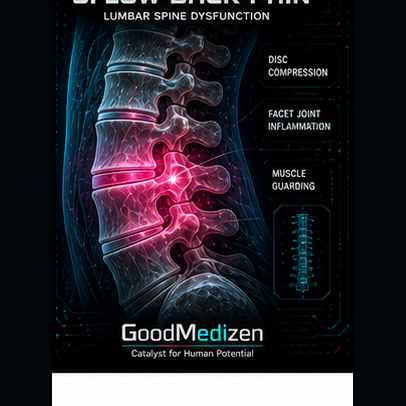
Facet joint dysfunction. The facet joints between vertebrae can become inflamed, restricted, or develop degenerative changes that alter how they move. Facet pain tends to be localized, worse with extension (leaning backward), and often refers into a narrow band of territory near the spine. Chronic facet dysfunction also drives the surrounding multifidus muscles into protective spasm, which further restricts movement and perpetuates the pattern.
Disc-related referred pain. Disc issues cause pain through two mechanisms: direct mechanical compression of a nerve root (radiculopathy), and chemical irritation from inflammatory mediators released by damaged disc tissue. Radicular pain follows a specific dermatomal pattern — L5 down the outer thigh and into the top of the foot, C6 into the thumb side of the forearm and hand. Chemical disc pain produces a more diffuse ache that doesn't respect nerve boundaries.
Sacroiliac joint dysfunction. The SI joints, where the sacrum meets the pelvis, can become inflamed, stuck, or hypermobile. SI dysfunction refers pain into the low back, buttock, and sometimes down the leg in patterns that get misdiagnosed as disc-related sciatica. It's a common driver of low back pain that doesn't improve with spine-focused treatment.
Central sensitization. In chronic pain states, the nervous system itself becomes the problem. Prolonged pain input sensitizes the spinal cord and brain to pain signals, lowering the threshold at which normal input gets interpreted as painful. This is why chronic back pain can worsen over time even when the original tissue injury has healed — the alarm system has been cranked up and can't turn itself down.
Visceral referred pain. The spine shares nerve pathways with internal organs, which means organ dysfunction can produce pain that feels musculoskeletal. Gallbladder problems refer into the right shoulder and mid-back. Kidney issues refer into the flank and low back. Pelvic floor dysfunction refers into the sacrum and low back. Sometimes what looks like a persistent back problem is actually an organ telling you something through a cross-wired communication line.
Postural and kinetic chain compensations. The body treats the spine as the central mast of a rigging system. When something downstream is off — an old ankle sprain that changed how you push off, a hip that doesn't rotate properly, a foot that overpronates — the spine absorbs the compensation. Fix the ankle, the back calms down. Fix the back alone, the ankle sabotages you again in three months.
Most chronic back and neck pain we see involves more than one of these at once. Which is why treatment that addresses only one component tends to produce only partial, temporary results.
Where TCM Comes In
Chinese medicine has been treating spine pain for thousands of years, and its frameworks map surprisingly well onto modern pain science. The primary relevant meridians — the Bladder channel running down the entire length of the back, the Gallbladder channel along the side of the neck and shoulders, and the Du mai running directly over the spine — correspond almost exactly to the fascial planes and muscle groups that develop the most chronic tension.
Wind-Cold-Damp Bi Syndrome describes acute pain that's worse in cold or wet weather and improves with warmth. Corresponds to the inflammatory pattern where reduced circulation and increased muscle guarding make pain more sensitive to environmental changes.
Qi and Blood Stagnation produces sharp, fixed, stabbing pain often at a specific point. Tracks with myofascial trigger points and localized inflammation — areas where circulation is impaired and metabolic waste accumulates.
Kidney Deficiency with Bi Syndrome is the chronic, recurring low back pain with knee weakness, fatigue, and history of overwork or aging. Corresponds to degenerative changes, connective tissue decline, and the long-term patterns that make people susceptible to repeated flares.
Liver Qi Stagnation describes pain that clearly tracks with stress and emotional pressure, often with muscle tension that wanders from one area to another. Corresponds to sympathetic nervous system activation and the role of stress in amplifying pain perception.
Identifying the TCM pattern tells us about the character of the problem — acute vs chronic, inflammatory vs deficient, central vs peripheral — and shapes everything from point selection to herbal prescription to how aggressive treatment can be.
How We Treat Back and Neck Pain at GoodMedizen
At GoodMedizen, we treat musculoskeletal conditions using our proprietary system — Tissue Response Assessment and Corrective Strategy, or TRACS. This approach integrates the needling of myofascial trigger points with careful attention to timing, sequence, and related structures to create a comprehensive treatment protocol that delivers more effective and longer-lasting results than standard acupuncture protocols alone.
We don't just needle where it hurts. We evaluate the whole kinetic chain — spine, pelvis, shoulders, hips, deep stabilizers, fascia — identify which specific tissues are holding the problem, and treat them in an order that allows the pattern to unwind rather than just temporarily quiet down.
Alongside TRACS, we use:
Traditional acupuncture for pain modulation and inflammation reduction. Acupuncture has well-documented effects on descending pain inhibitory pathways — it stimulates endogenous opioid release (beta-endorphin, enkephalin) and engages the periaqueductal gray, the body's natural pain-dampening system. For acute pain, we can significantly reduce signal transmission while the underlying tissue heals. For chronic pain, regular treatment helps resensitize a nervous system that's been stuck in alarm mode.
Electroacupuncture when appropriate. Running low-frequency electrical current through needles at specific points enhances the analgesic effect and increases blood flow. Particularly useful for stubborn cases where trigger points are deep and chronic.
Point Injection Therapy (PIT). Rather than pharmaceutical steroids — which come with a well-documented list of side effects including tissue damage, tendon weakening, bone thinning, and blood sugar elevation — we inject therapeutic compounds directly into acupuncture points and trigger points. Our injectable toolkit includes:
- Homeopathic Traumeel — a botanical anti-inflammatory compound with comparable effectiveness to NSAIDs for reducing pain, swelling, and inflammation, with a significantly better safety profile (Schneider, 2011)
- Homeopathic Zeel — plant extracts that stimulate growth factor release, protect cartilage, and promote tissue regeneration; particularly useful in degenerative conditions
- Spascupreel — homeopathic formula for muscle spasm and cramping patterns
- Procaine and Lidocaine — local anesthetics that restore normal nerve membrane potential and can deactivate trigger points directly
- Methylcobalamin and Hydroxocobalamin (B12) — active forms of B12 that support nerve repair and myelin regeneration
- Sarapin — an FDA-approved, AMA-recognized botanical compound derived from pitcher plant, used for over 70 years in pain medicine
Peptide therapy for appropriate cases — particularly traumatic injuries and cases with significant nerve involvement. BPC-157 and TB-500 have emerging research supporting tissue repair, tendon and ligament healing, and anti-inflammatory effects. KPV is used when nerve involvement and neuroinflammation are part of the picture.
Cupping, gua sha, and moxibustion address fascial restrictions, improve local circulation to ischemic tissue, and (with moxibustion) provide targeted warming for cold-pattern conditions.
Chinese herbal medicine supports tissue repair, reduces systemic inflammation, and addresses the underlying constitutional pattern — blood deficiency, dampness accumulation, or kidney yang deficiency, which in TCM correlates with the structural integrity of the spine.
Functional movement assessment. We evaluate how you actually move — gait, rotation, hip mobility, core activation, foot mechanics — and identify compensation patterns that are perpetuating the problem. Most recurrent back and neck pain has a kinetic chain origin that treatment needs to address if results are going to hold.
Referral when appropriate. If the presentation suggests an issue that requires imaging, neurosurgical evaluation, or medical workup we don't do in-house, we make the referral. We're not trying to handle every case with needles — we're trying to get you the right care from the right people in the right order.
When to Consider Us
- You've been dealing with back or neck pain for weeks or months and it isn't resolving
- Physical therapy helped but the pain returns whenever you stop the exercises
- Your MRI showed findings that don't fully explain your symptoms
- Your MRI was clean but you still have significant pain
- You've had cortisone injections that worked temporarily but didn't last
- You're trying to avoid surgery and want to see if conservative, integrated treatment can resolve it
- You've had a spinal procedure that helped initially but symptoms have returned
- You're dealing with a flare after a specific incident — accident, fall, heavy lift, or prolonged travel
- Your pain tracks with stress, poor sleep, or seasonal changes
Selected References
- Qin, Z., et al. (2015). Acupuncture for chronic low back pain: A meta-analysis. Am J Chin Med, 43(8), 1543–1559.
- Lee, J. H., et al. (2013). Acupuncture for acute low back pain: A systematic review. Clin J Pain, 29(2), 172–185.
- Brinjikji, W., et al. (2015). Systematic literature review of imaging features of spinal degeneration in asymptomatic populations. AJNR Am J Neuroradiol, 36(4), 811–816.
- Travell, J. G., & Simons, D. G. (1999). Myofascial Pain and Dysfunction: The Trigger Point Manual. Lippincott.
- Trinh, K. V., et al. (2016). Acupuncture for neck disorders. Cochrane Database Syst Rev, 5, CD004870.
- Schneider, C. (2011). Traumeel: An emerging option to NSAIDs in acute musculoskeletal injuries. PMC 3085232.