.png)
catalyst for human potential
downtown seattle's home for personalized, integrative care: acupuncture, herbs, and functional medicine
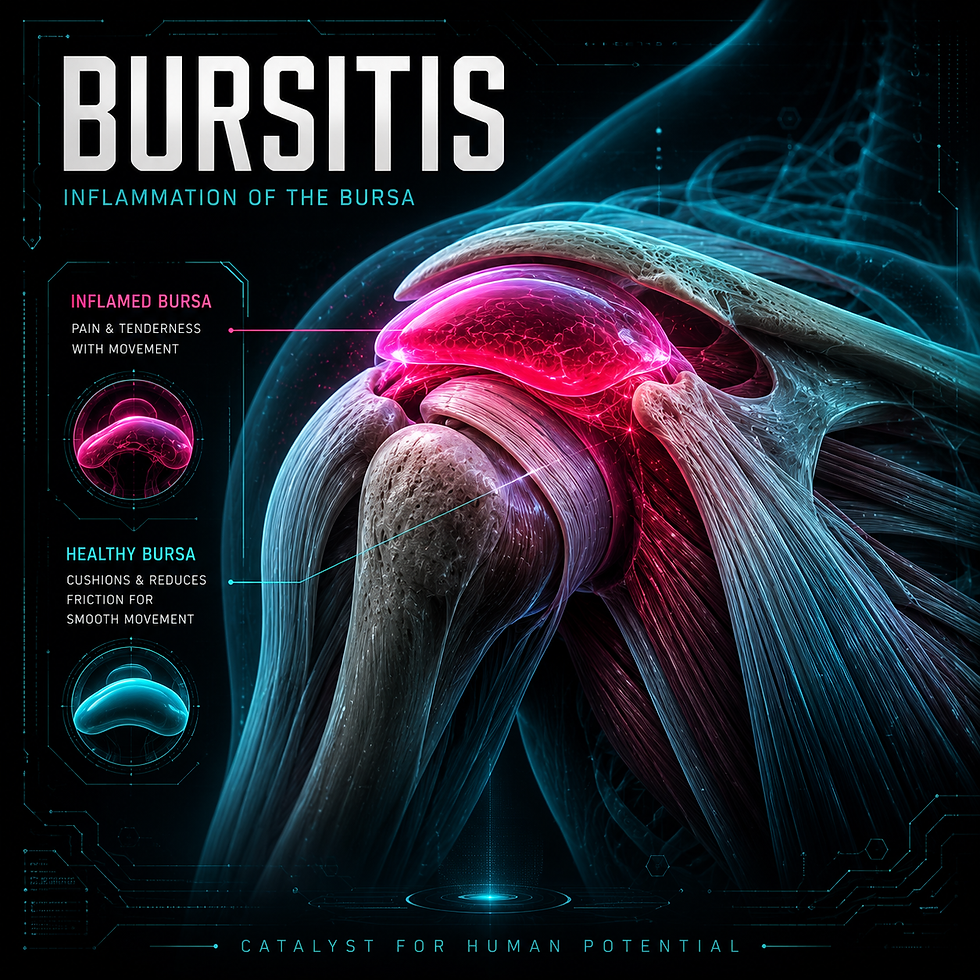
Bursitis Is Rarely Just an Angry Bursa
The textbook description of bursitis is simple: a bursa — one of the small, fluid-filled sacs that cushion friction points between bone, tendon, and skin — gets inflamed. Treat the inflammation, rest the joint, and move on.
That framing works when the trigger is obvious and acute — you whacked your elbow on a countertop, knelt on a hard floor for six hours, took a fall on your hip. Rest and ice usually handle it. What it doesn't explain is the much more common pattern we see in the clinic: bursitis that keeps coming back to the same shoulder, hip, or knee no matter how many cortisone injections, anti-inflammatories, or weeks of rest the patient goes through.
A bursa doesn't randomly decide to inflame. It inflames because something is repeatedly compressing it, rubbing it, or flooding the local tissue with inflammatory signaling. If treatment only targets the bursa itself — numb it, drain it, inject it — the cause that was compressing or inflaming it in the first place is still there. Which is why recurrent bursitis is less of a tissue problem and more of an input problem.
What Bursitis Actually Is
Bursae are small, fluid-filled sacs placed strategically throughout the body wherever there's repeated friction — where tendons glide over bone, where skin moves across underlying bone, where muscles shift against each other. Healthy bursae are thin, produce a small amount of lubricating fluid, and you never notice they exist.
When a bursa becomes irritated — by direct trauma, by chronic compression from tight surrounding muscles, by overuse patterns, or by systemic inflammation flooding the local tissue — the synovial cells lining the bursa start producing more fluid and releasing inflammatory mediators (IL-1, IL-6, prostaglandins). The bursa swells. The swelling creates more pressure against surrounding tissues, which creates more friction and compression, which drives more inflammation. Without something to break the cycle, the bursa can stay inflamed for weeks or months.
We see bursitis at a handful of predictable sites:
- Subacromial bursitis — top of the shoulder, usually alongside rotator cuff irritation and tied to shoulder impingement patterns
- Trochanteric bursitis — outside of the hip, typically driven by glute medius weakness and IT band tension
- Iliopsoas bursitis — deep in the front of the hip, tied to hip flexor tightness and psoas dysfunction
- Prepatellar bursitis ("housemaid's knee") — front of the knee, from prolonged kneeling or direct impact
- Pes anserine bursitis — inside of the knee, tied to knee valgus patterns and tight medial structures
- Olecranon bursitis — back of the elbow, from pressure or impact
- Retrocalcaneal bursitis — back of the heel, tied to Achilles tendon issues and calf tightness
One clinical note worth flagging: septic bursitis (bacterial infection of the bursa) can look similar to mechanical bursitis but requires antibiotics or drainage, not conservative care. If a bursa is hot, red, progressively worsening, or accompanied by fever, that's urgent care or ER — not an acupuncture appointment.
Where Bursitis Actually Comes From
Muscular compensation creating chronic compression. This is the driver we see most often in recurrent bursitis. The muscles surrounding the joint develop trigger points or altered resting tension that pulls the joint into a position where the bursa gets pinched. The patient rests. The bursa calms down. They return to the same movement pattern, the bursa gets pinched again, and the cycle restarts. The tissue itself isn't the problem — the forces acting on it are.
Asymmetric loading. A subtle leg length discrepancy, an old ankle sprain that changed how you transfer weight, a dominant-side pattern from a sport or occupation — any of these can load one hip, knee, or shoulder harder than the other. Over years, the overloaded side accumulates inflammation that eventually expresses as bursitis. Fixing the bursa without addressing the mechanical asymmetry loses to it eventually.
Systemic inflammatory load. Gut dysbiosis, metabolic dysfunction, food sensitivities, and chronic stress all raise baseline inflammation in the body. When systemic inflammation is elevated, tissues under even modest mechanical stress inflame more easily and resolve more slowly. Bursitis at multiple sites — especially when it migrates around — is often a sign that the systemic inflammatory picture needs attention, not just the specific bursa.
Underlying inflammatory arthropathies. Rheumatoid arthritis, gout, and other inflammatory arthritic conditions can present with bursitis as part of their picture. Recurrent bursitis at multiple sites without a clear mechanical explanation warrants a rheumatologic workup.
Nutrient and metabolic factors. Low vitamin D, omega-3 deficiency, and unstable blood sugar all shift the inflammatory balance. Patients whose glucose swings significantly across the day have more tissue-level inflammation than their diet alone would predict — and more trouble resolving localized flares like bursitis.
Posture and sustained positioning. Desk work with forward head posture and rounded shoulders compresses the subacromial space and creates the mechanical setup for shoulder bursitis. Prolonged sitting with hip flexed compresses the iliopsoas region. The bursa inflames because the geometry of the surrounding structures keeps it in a pinched position for hours a day — treating the bursa without changing the posture is treating the symptom and ignoring the setup.
Where TCM Comes In
Chinese medicine categorizes most bursitis presentations within Bi syndrome — the same framework used for arthritis and other painful obstruction patterns — with the specific pattern shaping the treatment approach.
Damp-Heat Bi — swollen, warm, red bursae that feel heavy and worsen with humidity. Corresponds to acute inflammatory bursitis with significant local swelling and warmth.
Qi and Blood Stagnation — sharp, fixed pain that's worse with pressure and typically follows trauma or overuse. Corresponds to the mechanical compression patterns that drive most recurrent bursitis.
Cold-Damp Bi — achy, stiff, swollen presentations that flare with cold and damp weather. Corresponds to chronic low-grade bursitis that the patient notices seasonally.
Kidney Deficiency with Local Stagnation — chronic presentations, often in older patients, where local inflammation sits on top of a deeper constitutional depletion. Corresponds to the recurrent bursitis pattern where tissue just isn't recovering between flares.
The TCM pattern tells us whether treatment needs to move blood and qi locally, clear heat and drain damp, warm the channel, or tonify the constitution — which shapes acupuncture point selection, herbal prescribing, and the modalities we layer in.
How We Treat Bursitis at GoodMedizen
At GoodMedizen, we treat musculoskeletal conditions using our proprietary system — Tissue Response Assessment and Corrective Strategy, or TRACS. This approach integrates the needling of myofascial trigger points with careful attention to timing, sequence, and related structures to create a comprehensive treatment protocol that delivers more effective and longer-lasting results than standard acupuncture protocols alone.
For bursitis specifically, TRACS matters because the bursa itself is almost never the actual driver. The muscles creating the compression — the upper trap and pec minor for subacromial bursitis, the glute medius and TFL for trochanteric bursitis, the adductors for pes anserine bursitis — are what need to change for the bursa to stop re-inflaming. Treating the bursa in isolation is the reason so many patients end up stuck in the three-cortisone-injection cycle that never actually resolves the underlying problem.
Alongside TRACS, we use:
Traditional acupuncture reduces local inflammation, improves blood flow to the affected area, and engages the body's endogenous pain control systems. For acute bursitis, acupuncture often provides significant relief within the first few sessions. For chronic or recurrent cases, regular treatment supports the longer process of changing the muscular and fascial patterns that created the problem in the first place.
Electroacupuncture adds low-frequency current to needles placed in and around affected trigger points. For deeper bursae — iliopsoas, subacromial, retrocalcaneal — this extends the reach of the treatment and enhances both the circulatory and analgesic effects.
Point Injection Therapy (PIT) is one of the most valuable tools we have for bursitis because it delivers anti-inflammatory compounds directly into the inflamed tissue without the cartilage damage and tissue thinning that comes with repeated cortisone use. Our injectable toolkit includes:
- Homeopathic Traumeel — botanical anti-inflammatory with comparable effectiveness to NSAIDs for reducing pain and swelling, significantly better safety profile (Schneider, 2011)
- Homeopathic Zeel — growth factor release, connective tissue protection, tissue regeneration
- Spascupreel — for the muscle spasm and guarding that accompanies most bursitis presentations
- Procaine and Lidocaine — local anesthetics that deactivate the trigger points driving compression of the bursa
- Methylcobalamin and Hydroxocobalamin (B12) — where nerve irritation is part of the picture
- Sarapin — FDA-approved botanical compound with a 70+ year history in pain medicine
Peptide therapy where tissue repair needs additional support. BPC-157 and TB-500 have emerging research for tendon and soft tissue healing, and can be useful when bursitis is layered on top of chronic tendinopathy.
Cupping, gua sha, and moxibustion for the fascial restrictions and muscle tension surrounding the affected bursa. Moxibustion is particularly useful for cold-pattern presentations where warming the local area moves stagnation and reduces pain.
Chinese herbal medicine tailored to the pattern. Formulas that move blood and reduce swelling for acute presentations, clear damp-heat for inflammatory flares, warm the channel for cold-damp presentations, and tonify the constitution for chronic-recurrent patterns.
Functional movement assessment. We look at the mechanical pattern that's creating the compression. A patient with subacromial bursitis often has restricted thoracic rotation and an anterior shoulder position. A patient with trochanteric bursitis often has weak glute medius and excessive hip adduction during gait. Identifying and correcting the pattern is what keeps the bursitis from coming back after the acute inflammation resolves.
Functional medicine. For patients with recurrent bursitis at multiple sites, we assess hs-CRP, metabolic markers, vitamin D, omega-3 status, and where relevant, gut and autoimmune markers. Addressing the systemic inflammatory load is what separates real resolution from another cortisone cycle.
Lifestyle integration. Targeted strengthening of the weak links in the movement chain, adjustment of the positions or activities that keep re-irritating the bursa, anti-inflammatory nutrition, and sleep and stress support. The tissue can't stay calm if the mechanical and systemic environment keeps pushing it toward inflammation.
When to Consider Us
- You've had cortisone injections for bursitis and it keeps coming back
- You have recurrent bursitis at multiple sites
- You want to avoid steroid injections but still need real relief
- You're an athlete or active person trying to prevent recurrence
- You're a desk worker with chronic shoulder, hip, or knee bursitis
- You have bursitis alongside other inflammatory conditions
- You've been told surgery is the next step and want to explore alternatives first
- You want to understand what's actually driving the inflammation rather than just suppressing it
Selected References
- Schneider, C. (2011). Traumeel: An emerging option to NSAIDs in acute musculoskeletal injuries. Int J Gen Med, 4, 225–234. PMC 3085232.
- Birnesser, H., et al. (2004). The homeopathic preparation Zeel comp N compared to hyaluronic acid for knee osteoarthritis. J Musculoskelet Res, 8(2-3), 119–128.
- Molsberger, A. F., et al. (2010). German randomized acupuncture trial for chronic shoulder pain. Pain, 151(1), 146–154.
- Lewit, K. (1979). The needle effect in the relief of myofascial pain. Pain, 6(1), 83–90.
- Williams, B. S., Cohen, S. P. (2009). Greater trochanteric pain syndrome: a review of anatomy, diagnosis and treatment. Anesth Analg, 108(5), 1662–1670.
- Speed, C. A. (2001). Fortnightly review: Corticosteroid injections in tendon lesions. BMJ, 323(7309), 382–386.