.png)
catalyst for human potential
downtown seattle's home for personalized, integrative care: acupuncture, herbs, and functional medicine
Chronic Sinusitis
Relieve chronic sinus pressure, congestion, and recurrent sinus infections with acupuncture.
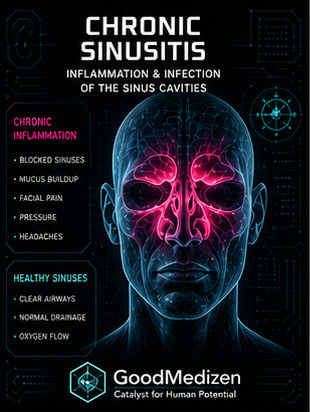
When Your Sinuses Never Quite Clear
Chronic sinusitis erodes quality of life quietly — not dramatic enough for the ER, but persistent enough to wear down your sleep, energy, focus, and mood for months or years. Pressure behind the eyes, facial pain, post-nasal drip, congestion that antibiotics clear for a while but never for good. The usual cycle is antibiotics, nasal steroids, antihistamines, then a referral and a CT scan, with surgery offered if the anatomy is the issue. What goes underaddressed is why the sinuses are inflamed in the first place. The body is not malfunctioning; it is responding to inputs that keep the inflammation running.
This is the GoodMedizen lens. The body is not malfunctioning. It is responding accurately to the information it is being given. Change the inputs and the response begins to change with them.
What Chronic Sinusitis Actually Is
The sinuses are air-filled cavities lined with the same mucosa as the rest of the airway, draining through small openings into the nose. When that drainage is blocked or the lining is chronically inflamed, debris accumulates and inflammation feeds itself. Acute sinusitis, under four weeks, is usually viral and self-resolving. Chronic sinusitis, lasting past twelve weeks despite treatment, is a different animal — persistent inflammation that is often not primarily an infection at all, but an immune and environmental problem. The immune pattern is frequently the same allergic, Th2-dominant pattern seen in asthma and eczema, which is why those conditions so often travel together.
What Is Actually Driving It
- Allergic inflammation, where airborne allergens trigger swelling and mucus that block drainage and set up the infection cycle
- Mold and fungal sensitivity, significantly underdiagnosed, which can perpetuate sinus inflammation with no active infection
- A disrupted gut microbiome, which skews immunity toward the allergic, inflammatory pattern
- Food contributors, dairy most commonly, through thickened mucus and mucosal inflammation
- Environmental exposures — dry indoor air, occupational irritants, smoke — that keep the lining irritated
Why It Gets Missed
Chronic sinusitis is managed as a series of infections to clear rather than an inflammatory pattern to calm, so the same antibiotics get prescribed again and again while the allergic, gut-driven, or environmental driver continues underneath.
Signs and Patterns
- Sinuses that never fully clear between infections
- Antibiotics that help briefly while symptoms always return
- Facial pressure or pain and post-nasal drip
- Concurrent asthma, eczema, or allergic rhinitis
- Thick or discolored discharge
- Symptoms worse in particular buildings or seasons
- Digestive symptoms alongside the sinus problems
How We Look at It — The Testing
- Allergy and immune pattern — IgE testing for common inhaled allergens and assessment of the allergic, Th2-dominant pattern
- Mold and fungal exposure — a urinary mycotoxin panel and a careful environmental history where exposure is suspected
- The gut — GI-MAP through Diagnostic Solutions, given the gut’s influence on mucosal immunity
- Mucosal and immune foundations — 25-OH vitamin D around 60 to 70, zinc, and omega-3 status
- Inflammation — hs-CRP and a CBC with differential for the neutrophil-to-lymphocyte ratio
- Food contributors — assessed clinically, with dairy the usual first suspect, and with appropriate caveats where testing is used
Broad baseline labs do not have to be expensive. Services such as Function Health let patients obtain large workups affordably, and we have no financial stake in that — we would rather your budget go toward care than toward lab markups. For targeted functional testing we order through Diagnostic Solutions (GI-MAP) for the microbiome, Quicksilver Scientific for heavy metals, and through Fullscript where it serves you best, with every marker read against optimal ranges rather than the wide line between “normal” and “abnormal.”
The Chinese Medicine Lens
Chinese medicine has treated nasal and sinus conditions for centuries. The nose is the opening of the Lung, and sinus problems are read as the Lung struggling to govern surface defense and move fluids through the nasal passages. Acute patterns are wind-cold or wind-heat invading the Lung; chronic patterns are Lung qi deficiency with phlegm-damp (chronic congestion, copious mucus, fatigue, recurrent infection), Stomach and Spleen damp-heat rising (thick, foul, yellow discharge with digestive symptoms), or Kidney yang deficiency in long-standing, depleted cases. Treatment is matched to the pattern and the stage.
The phlegm-damp and damp-heat patterns line up closely with the impaired drainage and gut-driven inflammation modern work identifies.
How Acupuncture and Functional Medicine Help
Acupuncture opens the sinuses and eases congestion quickly using points around the nose and face, and addresses the underlying immune and constitutional pattern with systemic points; trials show meaningful reductions in chronic sinus symptom scores with regular treatment. Chinese herbal medicine has classical formulas for each stage, drawing on herbs with documented effects on the nasal mucosa.
The functional work goes after the drivers: identifying and reducing allergic and environmental triggers, addressing mold where it is present, healing the gut, removing food contributors, and supplying the nutrients the mucosal immune system depends on. Open the exits and calm the terrain, and the sinuses stop relapsing.
Care That Works With Your Other Providers
Significant structural problems, nasal polyps, and infections that need imaging or specialist care belong with your physician or ENT, and we coordinate with them. We work alongside your medical care and never advise stopping a prescribed medication.
Your Body Isn’t Broken
If you have spent years being told your labs look normal while you clearly do not feel normal, you have not been imagining it. With chronic sinusitis, the work is to calm the inflammation and clear what keeps driving it, so the sinuses stop relapsing the moment the antibiotics stop. Your body is not broken. The support has just been missing.
At GoodMedizen in downtown Seattle, we treat the system driving the condition, not only the symptoms it produces.