.png)
catalyst for human potential
downtown seattle's home for personalized, integrative care: acupuncture, herbs, and functional medicine
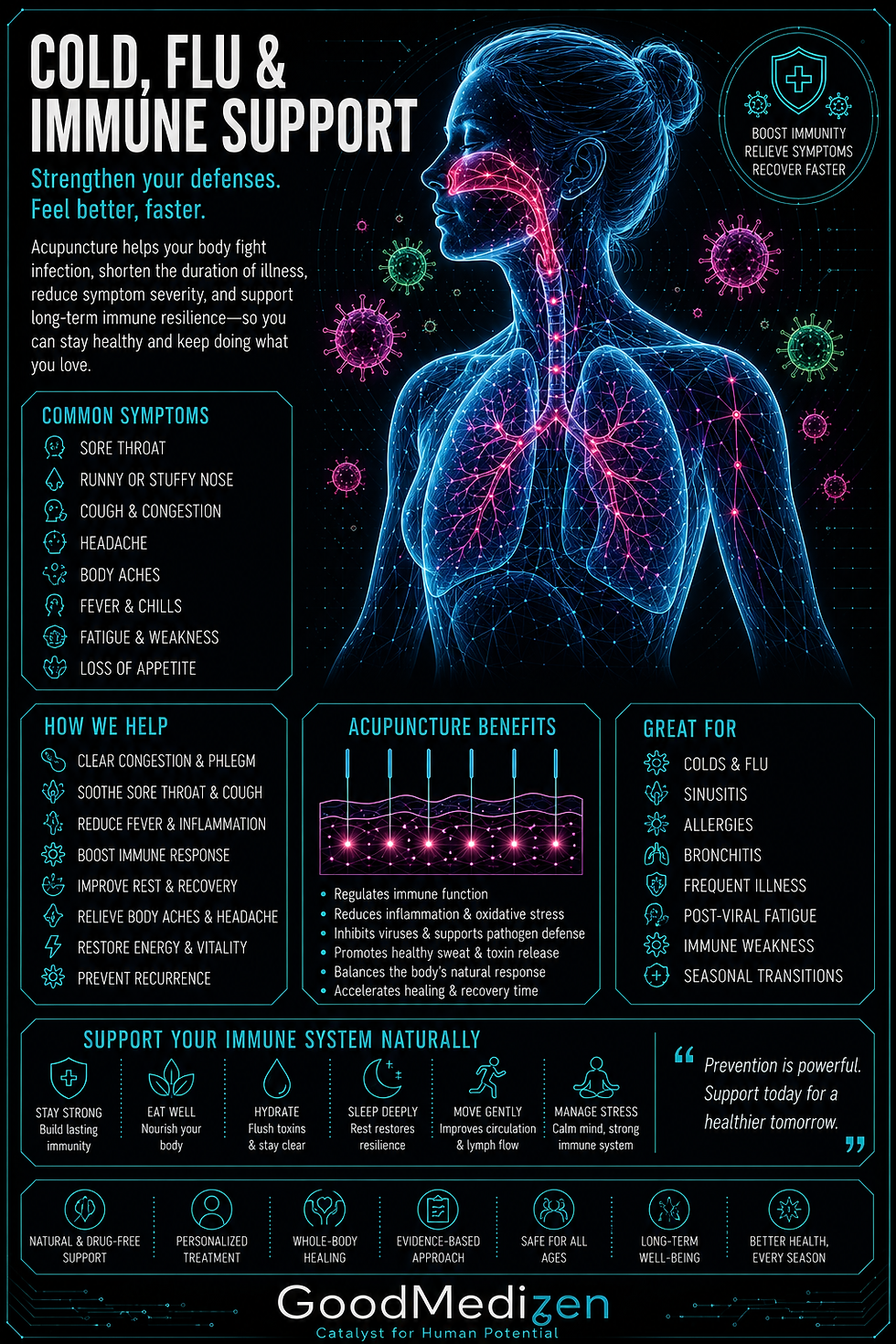
Cold Flu and Immune Support
Speed recovery from colds and flu, and strengthen immunity to prevent recurrence.
Your Immune System Does Its Best Work When You Give It Something to Work With
Getting sick is normal. Staying sick longer than you should, catching everything that goes around, or never quite recovering between rounds — that is a signal worth following. Conventional care treats acute illness as an event to suppress and leaves the underlying question alone: what decides whether a cold is three mild days or a week in bed? The body is not failing; its defenses are asking for support.
This is the GoodMedizen lens. The body is not malfunctioning. It is responding accurately to the information it is being given. Change the inputs and the response begins to change with them.
What Your Immune System Is Actually Doing
Immune function is not a single switch. It runs in layers — a fast, general first response, a slower targeted response with memory, and a regulatory layer that keeps the first two from overreacting. When a virus reaches the airway, the first responders move in, signal neighboring cells, and call up the targeted response. Fever is part of the design, not a flaw: it slows the virus and speeds the immune cells. A healthy system clears an ordinary infection in about a week to ten days. People who get sick often or recover slowly are usually carrying one or more fixable burdens underneath.
What Is Actually Driving It
- Low vitamin D, with receptors on nearly every immune cell; deficiency tracks closely with more frequent and more severe respiratory infections
- Low zinc, needed to build and run immune cells and carrying direct antiviral activity
- A disrupted gut microbiome, where the majority of immune cells live, which weakens the antibodies guarding mucosal surfaces
- Chronic stress, which suppresses key immune cells through cortisol
- Poor sleep, the window when immune memory consolidates and defenses regenerate
- Chronic low-grade inflammation that ties up immune resources
Why It Gets Missed
Acute illness gets treated symptom by symptom while the condition of the immune system — before, during, and after — goes unexamined. When someone simply gets sick a great deal, that is treated as bad luck rather than as a pattern with measurable, correctable drivers.
Signs and Patterns
- More than three or four infections a year
- Recovery that drags on longer than seems right
- Every bug hitting harder than it hits the people around you
- Lingering coughs or congestion after the illness itself passes
- Frequent illness alongside fatigue or digestive symptoms
- Getting sick predictably after stressful stretches or poor sleep
How We Look at It — The Testing
- Vitamin D — 25-OH vitamin D read to an optimal 60 to 70, not merely above the deficiency line
- Zinc and copper — assessed for balance, given zinc’s central immune role
- The gut — GI-MAP through Diagnostic Solutions, since mucosal immunity and the microbiome are inseparable
- Inflammation and immune cells — a CBC with differential including the neutrophil-to-lymphocyte ratio, and hs-CRP
- Foundations — a full iron and ferritin profile, B12 with homocysteine and MMA, and RBC magnesium
- Where illness is constant — a full thyroid panel with antibodies, since low thyroid function lowers resistance
Broad baseline labs do not have to be expensive. Services such as Function Health let patients obtain large workups affordably, and we have no financial stake in that — we would rather your budget go toward care than toward lab markups. For targeted functional testing we order through Diagnostic Solutions (GI-MAP) for the microbiome, Quicksilver Scientific for heavy metals, and through Fullscript where it serves you best, with every marker read against optimal ranges rather than the wide line between “normal” and “abnormal.”
The Chinese Medicine Lens
Chinese medicine has a detailed model of immunity in the wei qi — the defensive energy that circulates at the surface, warms the skin, controls the pores, and guards against outside pathogens, governed by the Lung and rooted in the Kidney. Lung qi deficiency shows as frequent colds, easy sweating, and a weak voice; Kidney yang deficiency as deep susceptibility with cold sensitivity and slow recovery; Spleen qi deficiency with damp as recurrent illness alongside digestive symptoms. Acute illness is treated differently from constitutional building — the stage of illness sets the strategy.
This is also one of the clearest overlaps between traditional categories and modern immunology: surface defense, deep reserve, and digestive foundation.
How Acupuncture and Functional Medicine Help
Acupuncture has measurable immune effects — supporting natural killer cell activity, white blood cell counts, and a balanced inflammatory response — and used regularly it lowers how often people catch respiratory infections. During acute illness it can open the airways and ease symptoms quickly.
Chinese herbal medicine is strong both for acute illness and for building resilience; the classical formula Yu Ping Feng San (Jade Windscreen) is among the most studied for shoring up surface defense. The functional work addresses the foundations — correcting vitamin D and zinc, healing the gut, protecting sleep, and lowering the stress load — filling the coffers so the system is ready before the next exposure.
Care That Works With Your Other Providers
High fever, trouble breathing, or illness that worsens rather than improves needs medical evaluation, and we will tell you when something belongs with your physician, especially if you are immunocompromised or managing a chronic condition. We work alongside your medical care and never advise stopping a prescribed medication.
Your Body Isn’t Broken
If you have spent years being told your labs look normal while you clearly do not feel normal, you have not been imagining it. With immunity, the work is to strengthen the system before the next exposure, not only to muscle through each illness after it arrives. Your body is not broken. The support has just been missing.
At GoodMedizen in downtown Seattle, we treat the system driving the condition, not only the symptoms it produces.