.png)
catalyst for human potential
downtown seattle's home for personalized, integrative care: acupuncture, herbs, and functional medicine
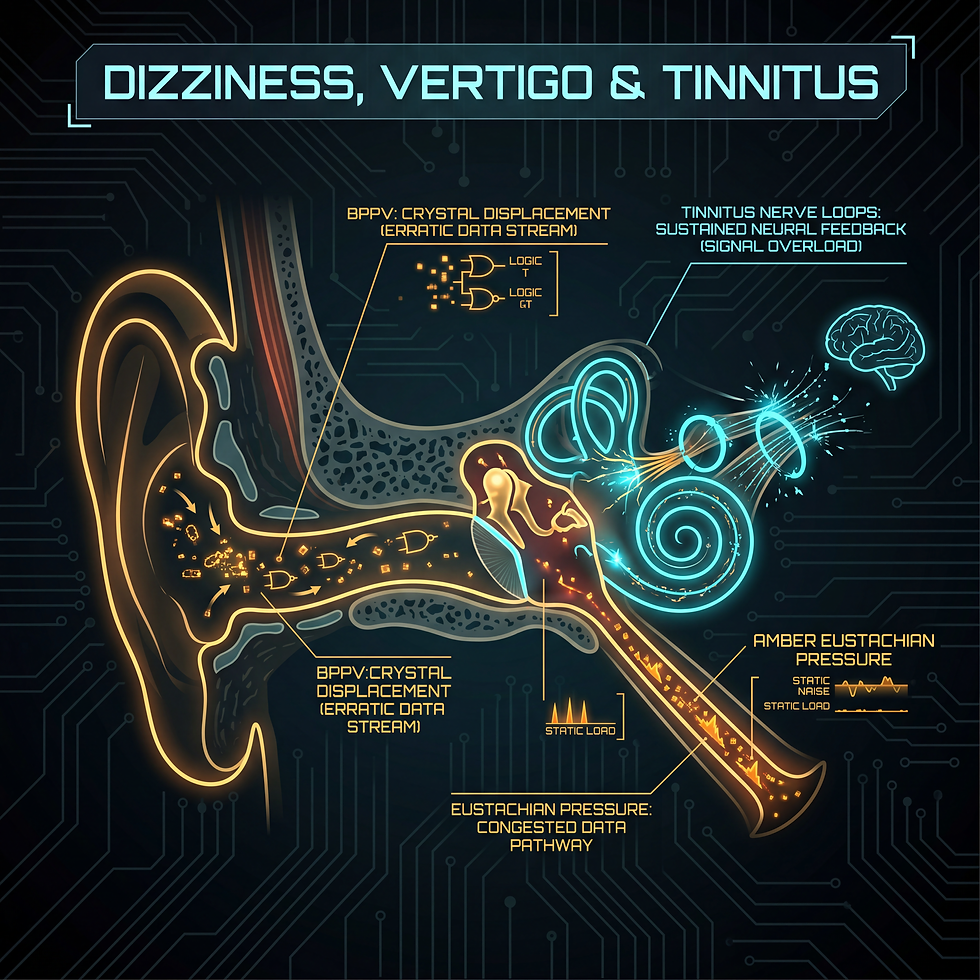
Dizziness, Vertigo, and Tinnitus Have Specific Causes — Worth Identifying
If you've been told your dizziness or tinnitus is something you'll have to live with — "we don't really know what causes it, just try not to focus on it" — you've encountered the limits of one of the more frustrating areas of conventional medicine. Vestibular and inner ear conditions are real, mechanism-rich, and often treatable. The challenge is that they sit at the intersection of neurology, ENT, cardiology, and structural medicine, and patients often bounce between specialists without anyone holding the whole picture.
The patterns we work with: BPPV (positional vertigo), Meniere's disease, vestibular migraine, persistent postural-perceptual dizziness (PPPD), cervicogenic dizziness, post-concussive dizziness, autonomic dysfunction (especially POTS), tinnitus alone or with hearing changes, and the broader category of "I just don't feel right when I move" that doesn't fit a clean diagnosis.
What's Actually Happening
Balance involves three sensory inputs (inner ear/vestibular system, vision, and proprioception from joints and muscles) integrated by the brainstem and cerebellum. Disruption at any level can produce dizziness, vertigo, or imbalance. Tinnitus often involves the auditory pathway but commonly co-occurs with vestibular issues because the systems share structures.
BPPV (benign paroxysmal positional vertigo). Otoconia (calcium crystals normally in the utricle) become displaced into the semicircular canals, producing brief but intense vertigo with specific head positions. Most common cause of vertigo. Treatable with specific repositioning maneuvers (Epley) but often missed or undertreated.
Meniere's disease. Episodes of vertigo with hearing loss, tinnitus, and ear fullness. Mechanism involves endolymphatic hydrops (fluid abnormalities in the inner ear). Multiple contributing factors — autoimmune, viral, vascular, sodium handling.
Vestibular migraine. Episodes of vertigo or imbalance with or without headache, often triggered by motion, visual stimulation, or hormonal changes. Migraine biology in the vestibular pathway. Often missed because vertigo doesn't always come with headache.
PPPD (persistent postural-perceptual dizziness). Chronic dizziness that persists after the initial trigger has resolved. Involves sensory mismatch and central nervous system patterning. Triggered by initial vestibular events, anxiety, or post-concussive states.
Cervicogenic dizziness. Dizziness driven by upper cervical dysfunction — muscle tension, joint restriction, vascular involvement. Often missed; responds to addressing the cervical spine.
Autonomic dizziness. Dizziness on standing or with postural changes from POTS, orthostatic hypotension, or other autonomic dysregulation.
Tinnitus mechanisms. Inner ear dysfunction (hearing loss often coexists), neural plasticity (the brain compensates for reduced auditory input by amplifying remaining signals), TMJ dysfunction affecting nearby structures, cervical spine involvement, certain medications, vascular factors. "Subjective" tinnitus (only the patient hears it) is more common; "objective" tinnitus (sounds the examiner can detect) involves vascular or muscular causes.
What Drives These Conditions
Vascular and circulatory factors. Reduced perfusion to the inner ear, vertebral artery insufficiency, microvascular dysfunction. Improving circulation often helps.
Inflammation. Chronic inflammation affects vestibular function, contributes to Meniere's, and drives migraine biology.
Cervical spine dysfunction. Upper cervical (C1-C3) restriction or muscular tension affects vestibular and auditory function through shared neural pathways and vascular supply.
Autonomic dysregulation. Affects blood pressure regulation, vestibular function, and tinnitus perception.
Hormonal influences. Vestibular migraine especially responds to hormonal patterns. Tinnitus and Meniere's often worsen perimenopausally.
Stress and anxiety. Tinnitus loudness perception and dizziness severity both increase with stress. The neural circuits involved overlap with limbic processing.
Nutritional factors. B12 deficiency causes neuropathy that can produce dizziness and tinnitus. Magnesium status affects vestibular and migraine biology. Sodium handling matters in Meniere's.
Medications. Many medications cause or worsen tinnitus and dizziness. Worth reviewing.
Where TCM Comes In
Chinese medicine has frameworks for dizziness, vertigo, and tinnitus that fit clinical patterns usefully.
Liver Yang Rising. Dizziness with headaches (often temporal or vertex), tinnitus, irritability, sometimes high blood pressure. Treatment subdues yang.
Phlegm-Damp obstruction. Heavy dizziness with brain fog, fullness in the head, sometimes nausea. Common in PPPD and post-viral dizziness. Treatment transforms phlegm.
Kidney Essence Deficiency. Tinnitus that's high-pitched, hearing decline with age, low back pain, fatigue. Treatment tonifies kidney essence.
Kidney Yin Deficiency with Empty Heat. Tinnitus worse at night, hot flashes, anxiety, dryness. Common in perimenopausal tinnitus and dizziness. Treatment nourishes kidney yin.
Liver Blood Deficiency. Dizziness, blurred vision, light-headedness, dry skin and nails, fatigue. Treatment nourishes liver blood.
Spleen Qi Deficiency with Damp. Dizziness with fatigue, brain fog, post-meal worsening, often digestive issues. Treatment tonifies the spleen.
How We Approach These Conditions
Coordinate with appropriate specialists. Audiology for hearing evaluation, ENT for structural assessment, vestibular PT for rehabilitation, neurology when migraine or central involvement is suspected. We don't replace these evaluations.
Acupuncture has documented effects on vertigo, tinnitus, and Meniere's symptoms. Multiple studies show meaningful symptom reduction, especially for tinnitus loudness perception and vestibular migraine. Specific protocols address ear and head circulation, autonomic regulation, and the TCM pattern.
Chinese herbal medicine for the specific TCM pattern. Several formulas have direct evidence for tinnitus and dizziness. Selection requires expertise.
Address cervical involvement. When upper cervical dysfunction is part of the picture, treatment includes acupuncture for the cervical region, sometimes coordinated with manual therapy or chiropractic. Addressing this often produces immediate improvement.
Functional medicine workup. B12 and methylation status, magnesium, full thyroid panel, hormone panels in suspected hormonal patterns, blood pressure patterns and orthostatic vitals, food triggers in vestibular migraine.
Targeted nutritional support. Magnesium for migraine and vestibular biology, B12 if low, vitamin D, omega-3s for inflammation, sometimes specific botanical support (Ginkgo for tinnitus has mixed but supportive evidence).
Address contributors. Sleep optimization, stress regulation, addressing reflux when present, identifying medication contributors, blood pressure management.
Vestibular rehabilitation. When indicated, we coordinate with vestibular PT for exercises that retrain the vestibular system. Particularly important for PPPD and post-concussive dizziness.
When to Consider Us
- You have chronic dizziness that hasn't been fully diagnosed or resolved
- You have tinnitus alone or with hearing changes
- You have Meniere's disease and want comprehensive integrative support
- You have vestibular migraine and want pattern-aware care
- You have PPPD or persistent post-vestibular event dizziness
- You suspect cervical involvement in your dizziness or tinnitus
- You have post-concussive dizziness or balance issues
- You have orthostatic dizziness or POTS-related symptoms
- You have age-related tinnitus or hearing decline and want supportive care
- Your symptoms have a clear hormonal or stress-related pattern
Selected References
- Hilton, M. P., & Pinder, D. K. (2014). The Epley (canalith repositioning) manoeuvre for benign paroxysmal positional vertigo. Cochrane Database Syst Rev, 12, CD003162.
- He, J., et al. (2017). Acupuncture for treatment of tinnitus: A systematic review and meta-analysis of randomized controlled trials. PLoS One, 12(4), e0173966.
- Lopez-Escamez, J. A., et al. (2015). Diagnostic criteria for Menière's disease. J Vestib Res, 25(1), 1–7.
- Lempert, T., et al. (2012). Vestibular migraine: Diagnostic criteria. J Vestib Res, 22(4), 167–172.
- Staab, J. P., et al. (2017). Diagnostic criteria for persistent postural-perceptual dizziness. J Vestib Res, 27(4), 191–208.
- Sereda, M., et al. (2018). Sound therapy (using amplification devices and/or sound generators) for tinnitus. Cochrane Database Syst Rev, 12, CD013094.