.png)
catalyst for human potential
downtown seattle's home for personalized, integrative care: acupuncture, herbs, and functional medicine
Fertility Is About More Than Just Conceiving — It's About Creating the Conditions for a Healthy Pregnancy
If you're trying to conceive — whether you've just started, you've been trying for a year, or you're working with a fertility clinic — you've encountered the strange truth about modern reproductive medicine: the technology has advanced enormously, but the underlying physiology has been somewhat sidelined. IVF success rates depend heavily on egg and sperm quality, uterine receptivity, and endocrine balance — all of which can be supported through integrative work, often dramatically.
Fertility is one of the areas where acupuncture and Chinese medicine have the strongest research support and clinical track record. Decades of studies and clinical experience converge on the same picture: regular acupuncture improves conception rates, supports IVF outcomes, helps regulate cycles, addresses common contributors to subfertility (PCOS, endometriosis, irregular cycles, luteal phase issues, sperm quality), and supports both partners in the conception journey.
This page is about fertility for everyone in the picture: people trying to conceive naturally, people working with fertility clinics, partners with sperm quality concerns, people preparing for pregnancy after pregnancy loss, people preparing for conception with autoimmune conditions, and people interested in optimizing fertility before they're actively trying.
What's Actually Happening in Fertility
Successful conception requires a coordinated cascade: appropriate hormonal signaling driving ovulation, healthy egg quality, adequate sperm quantity and motility, fallopian tube patency, fertilization, embryo development, and uterine receptivity for implantation. Disruption at any step affects outcomes.
Egg quality. Egg quality declines with age, but the trajectory varies enormously between individuals. Mitochondrial function in oocytes is increasingly recognized as central — eggs require enormous energy for the meiotic process. Oxidative stress, chronic inflammation, and nutrient deficits (especially CoQ10, antioxidants, omega-3s) all affect egg quality. The 90-day window before ovulation is when most of the relevant developmental changes happen, making it a key intervention window.
Sperm quality. Far more responsive to intervention than is generally appreciated. Sperm regenerate every 72-90 days, meaning targeted optimization can produce measurable changes in count, motility, and DNA integrity within a few months. Heat exposure, oxidative stress, certain medications, smoking, alcohol, and nutritional status all matter.
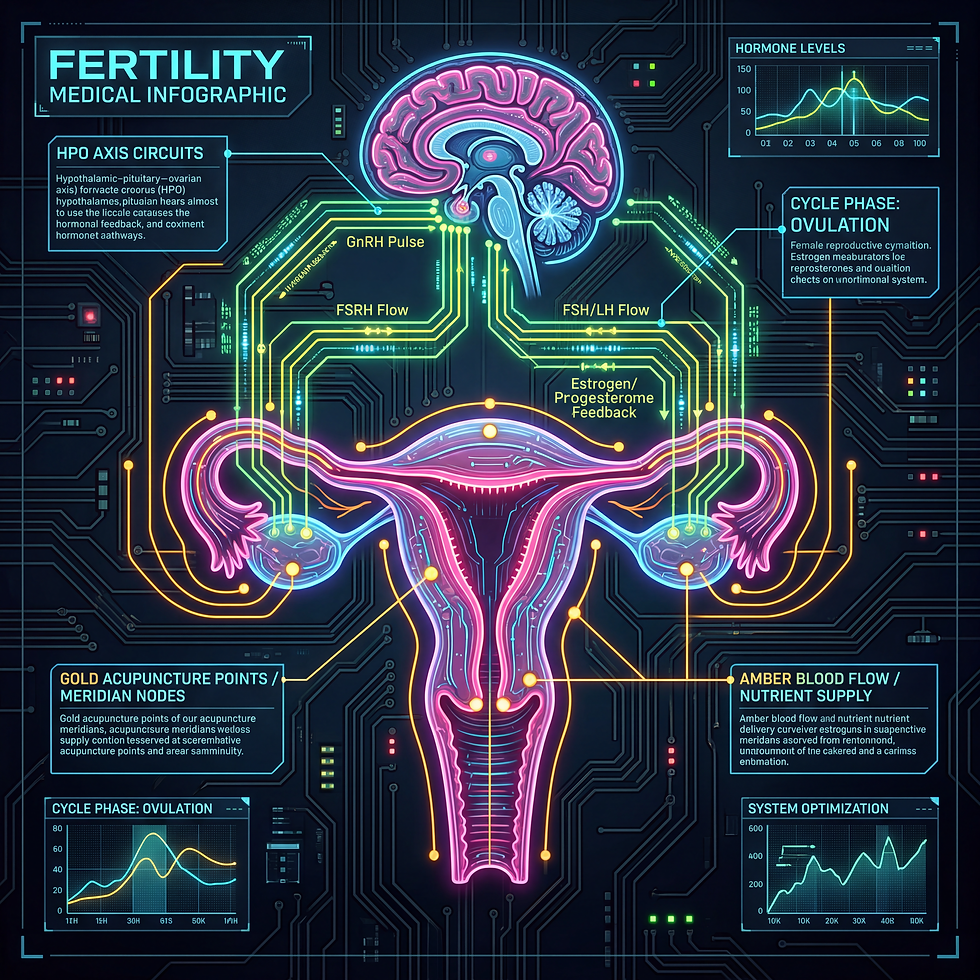
Cycle regulation. Reliable ovulation requires coordinated HPO axis function (hypothalamic-pituitary-ovarian). Stress, undereating, overexercising, thyroid dysfunction, prolactin elevation, and PCOS all disrupt ovulation.
Luteal phase function. The luteal phase (after ovulation, before menstruation) requires adequate progesterone for endometrial development and early embryo support. Short luteal phases or low progesterone affect implantation.
Uterine receptivity. The endometrium must develop a receptive state during the implantation window. Chronic endometritis, fibroids, polyps, adhesions, and inflammatory patterns affect receptivity.
PCOS and ovulatory dysfunction. Common cause of fertility issues. Insulin resistance, androgen excess, irregular ovulation. Responds well to integrative care including diet, exercise, targeted supplementation, and acupuncture.
Endometriosis. Affects fertility through multiple mechanisms — inflammation, anatomical distortion, immune effects on egg and embryo. Often underrecognized.
Thyroid dysfunction. Subclinical hypothyroidism, Hashimoto's, and hyperthyroidism all affect fertility. Antibody status matters even with normal TSH.
Autoimmune factors. Antiphospholipid antibodies, antinuclear antibodies, and other immune patterns can affect implantation and early pregnancy.
Stress and HPA axis. Chronic stress directly affects HPO function through several mechanisms. Cortisol patterns matter.
Toxic burden. Heavy metals, endocrine-disrupting chemicals, mold biotoxins all affect reproductive function. Pre-conception detoxification can be valuable when burden is identified.
Where TCM Comes In
Chinese medicine has been treating fertility for thousands of years, with detailed pattern frameworks specifically for reproduction.
Kidney Yang Deficiency. Cold uterus, irregular or absent cycles, low libido, fatigue, low back weakness, slow metabolism. Treatment warms kidney yang.
Kidney Yin Deficiency. Short cycles, dryness, scant menses, hot flashes, anxiety, insomnia. Common in older patients and stressed patients. Treatment nourishes kidney yin.
Blood Deficiency. Light scant periods, dry skin, fatigue, dizziness, pale tongue. Treatment nourishes blood.
Liver Qi Stagnation. Stress-driven cycle irregularity, PMS, breast tenderness, mood changes, sometimes anovulatory cycles. Treatment soothes liver qi.
Blood Stasis. Painful periods, dark clotted menses, endometriosis pattern, sometimes with structural issues. Treatment moves blood.
Phlegm-Damp. PCOS pattern, weight gain, sluggish ovulation, hirsutism, insulin resistance. Treatment transforms phlegm and clears damp.
Spleen Qi Deficiency. Fatigue, weak digestion, fluid retention, sometimes recurrent miscarriage from inadequate "holding." Treatment tonifies the spleen.
How We Approach Fertility
Fertility care is collaborative. We work alongside reproductive endocrinology when fertility clinics are part of the picture, with OB/GYN, and with primary care. We don't replace appropriate medical evaluation when indicated.
Acupuncture has substantial evidence in fertility care. Multiple meta-analyses have shown improved conception rates with acupuncture in both natural conception and IVF cycles. Specific protocols around embryo transfer have research support. Mechanism involves improved ovarian and uterine blood flow, HPO axis regulation, stress modulation, and TCM pattern-specific effects.
Chinese herbal medicine is one of the most powerful tools for fertility. Pattern-matched formulas address cycle regulation, egg quality, uterine receptivity, and the underlying pattern. Selection requires expertise — some formulas are inappropriate during specific cycle phases or once pregnancy is achieved.
Functional medicine workup. Comprehensive testing: full hormonal panel (FSH, LH, AMH, estradiol, progesterone, prolactin, testosterone, DHEA-S), full thyroid panel including antibodies, vitamin D, B12 and methylation status, ferritin, omega-3 index, fasting insulin and HbA1c, autoimmune markers when appropriate, comprehensive metabolic panel. For sperm: detailed semen analysis with DNA fragmentation testing when indicated.
Egg and sperm quality optimization. CoQ10 (especially ubiquinol), omega-3 fatty acids, antioxidants (vitamin C, vitamin E, alpha-lipoic acid, glutathione precursors), methylated B-complex (especially methylfolate, methyl B12), vitamin D to optimal levels, zinc and selenium for sperm. Inositol for PCOS patterns. NAC for endometriosis and PCOS. The 90-day window matters — starting interventions 3 months before active trying produces the best results.
Cycle support. Tracking with awareness, addressing luteal phase issues, supporting ovulation when irregular.
IVF support. Pre-cycle preparation (typically 3+ months for egg quality), cycle support, embryo transfer day acupuncture protocols (Paulus protocol has direct evidence), post-transfer support.
Address co-conditions. Thyroid optimization, gut health, autoimmune management, hormonal balance work, stress regulation.
Pre-conception detoxification. When toxic burden is identified, careful pre-conception detoxification can be valuable. Always completed before active trying — mobilizing toxins during pregnancy is contraindicated.
Partner support. Sperm quality optimization is typically more responsive than egg quality in shorter timeframes. Both partners benefit from preconception integrative care.
Lifestyle integration. Adequate sleep, stress regulation, appropriate exercise (not too little, not overtraining), nutrition focused on whole foods, alcohol reduction, smoking cessation, addressing environmental exposures.
When to Consider Us
- You're starting to think about conception and want to optimize fertility
- You've been trying to conceive without success
- You're working with a fertility clinic and want integrative support alongside conventional treatment
- You're preparing for IVF and want pre-cycle and cycle support
- You have PCOS, endometriosis, or irregular cycles affecting fertility
- You have a partner with sperm quality concerns
- You've experienced pregnancy loss and want preconception support
- You have autoimmune conditions and want to optimize before conception
- You're 35+ and want comprehensive support for egg quality
- You want to address potential toxic burden before conceiving
Selected References
- Manheimer, E., et al. (2008). Effects of acupuncture on rates of pregnancy and live birth among women undergoing in vitro fertilisation: Systematic review and meta-analysis. BMJ, 336(7643), 545–549.
- Paulus, W. E., et al. (2002). Influence of acupuncture on the pregnancy rate in patients who undergo assisted reproduction therapy. Fertil Steril, 77(4), 721–724.
- Stener-Victorin, E., et al. (2013). Acupuncture in polycystic ovary syndrome: Current experimental and clinical evidence. J Neuroendocrinol, 25(5), 462–474.
- Bentov, Y., & Casper, R. F. (2013). The aging oocyte — can mitochondrial function be improved? Fertil Steril, 99(1), 18–22.
- Showell, M. G., et al. (2017). Antioxidants for male subfertility. Cochrane Database Syst Rev, 1, CD007411.
- Cardenas-Trowers, O., et al. (2018). Vitamin D and female reproduction: A practical clinical approach. Curr Opin Obstet Gynecol, 30(6), 369–373.