.png)
catalyst for human potential
downtown seattle's home for personalized, integrative care: acupuncture, herbs, and functional medicine
Poor Circulation and Claudication
Claudication — from the Latin claudicare, meaning to limp — is pain caused by inadequate blood supply to working muscles.
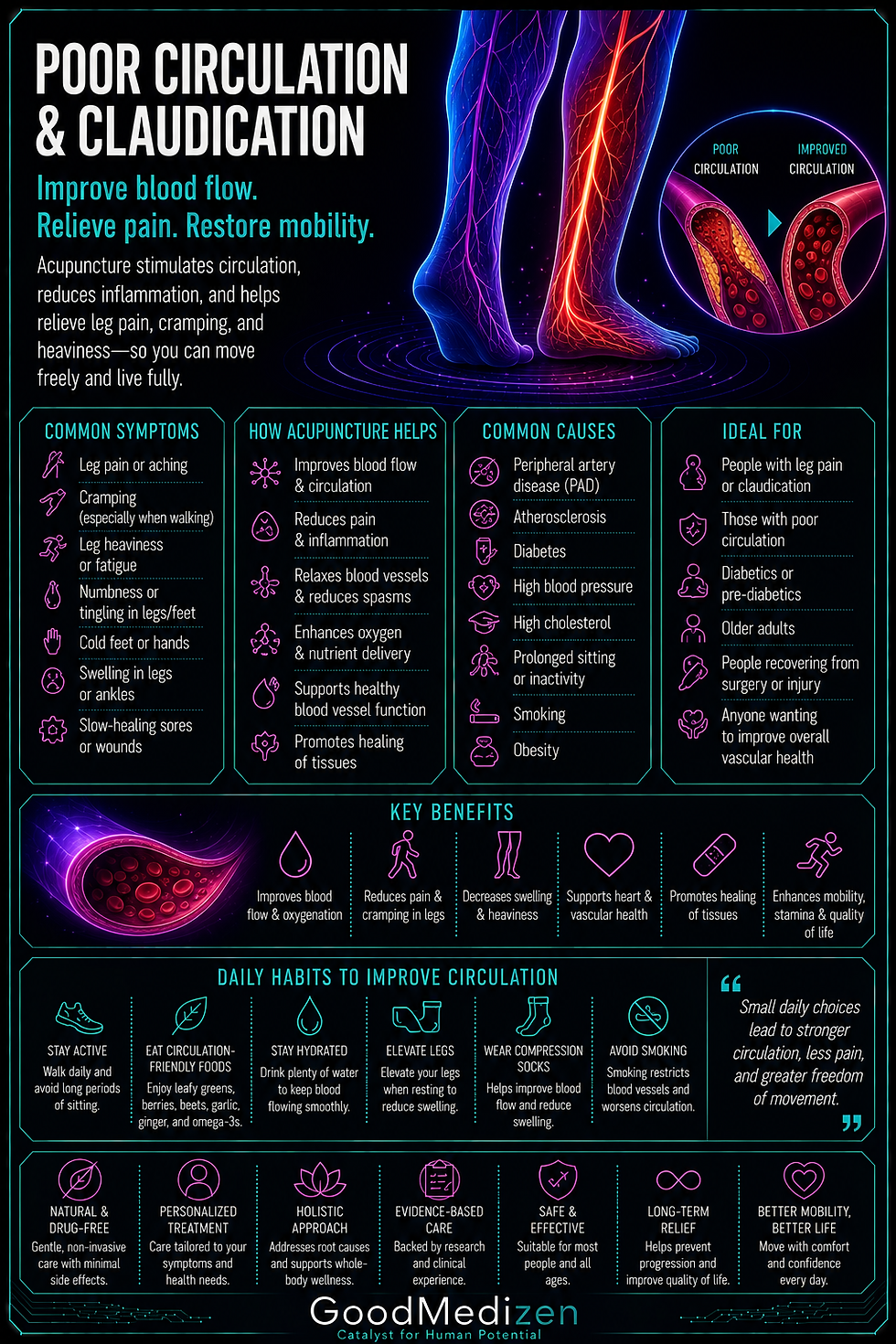
When Your Legs Start Rationing Their Own Blood Supply
Claudication is one of those symptoms that people often dismiss for too long. A cramp or ache in the calf, thigh, or buttock that shows up after walking a certain distance — and reliably goes away with rest. It can feel like being out of shape, like needing to stretch more, like just getting older. Until it starts happening after shorter and shorter distances. Until you're planning your day around whether you can walk from the parking lot to the store without stopping.
What's actually happening is that your legs have a blood supply problem, and the muscles are literally running out of oxygen under load. That pattern — predictable exercise-induced pain that resolves with rest — is the classic sign of peripheral arterial disease (PAD), and it's a warning signal that deserves serious attention. Not just because of the symptoms, but because of what it tells us about circulation throughout the entire body.
What Claudication Actually Is
Claudication — from the Latin claudicare, meaning to limp — is pain caused by inadequate blood supply to working muscles. Under resting conditions, the arteries feeding your leg muscles can usually deliver enough oxygen-rich blood to meet demand. When you start walking, muscles need significantly more oxygen and nutrients. In healthy arteries, blood flow increases to meet that demand. In arteries narrowed by atherosclerotic plaque, flow can't increase enough. The muscles run into oxygen debt. Anaerobic metabolism kicks in. Lactate and other metabolites accumulate. Pain signals fire.
Rest reduces muscle oxygen demand back to what the narrowed arteries can supply. Metabolites clear. Pain resolves. The cycle is predictable and is one of the most diagnostically useful patterns in vascular medicine.
The underlying disease process is atherosclerosis — the same process that causes coronary artery disease and many strokes. Plaque forms in arterial walls through a multi-step inflammatory cascade: endothelial damage (from oxidative stress, high blood pressure, smoking, or metabolic dysfunction), lipid infiltration into the damaged vessel wall, oxidation of those lipids, recruitment of immune cells, and progressive plaque formation that narrows the arterial lumen. The legs, carotids, coronaries, and cerebral circulation are all vulnerable to the same process — which is why claudication is never just a leg problem.
The ankle-brachial index (ABI) is the standard diagnostic tool: blood pressure in the ankle is compared to blood pressure in the arm. A normal ratio is 1.0 or close to it. Mild PAD shows an ABI of 0.7-0.9. Moderate PAD falls at 0.4-0.7. Severe PAD is below 0.4 and warrants urgent evaluation.
The Roots We Actually Find
Atherosclerosis and metabolic dysfunction. The vast majority of claudication is driven by atherosclerotic narrowing, and that process is driven by the full cluster of metabolic and inflammatory factors: insulin resistance, high blood pressure, LDL oxidation, elevated inflammatory markers, high homocysteine, smoking history, and chronic stress. Addressing claudication meaningfully requires addressing these drivers.
Endothelial dysfunction. Before plaque forms, the inner lining of arteries (the endothelium) loses its ability to appropriately dilate and regulate flow. Nitric oxide — a critical signaling molecule for vasodilation — becomes depleted. The endothelium becomes inflammatory and less responsive. This early stage is reversible with the right interventions.
Oxidative stress. Reactive oxygen species damage endothelial cells, oxidize LDL (making it pro-atherogenic), and deplete nitric oxide. Antioxidant defenses — glutathione, superoxide dismutase, vitamin C, vitamin E — are critical to preserving vascular health. When antioxidant status is chronically poor, vascular damage accelerates.
Inflammation. Chronic low-grade inflammation, measured by markers like hs-CRP, drives the entire atherosclerotic cascade. Inflammatory cytokines damage the endothelium, recruit immune cells into plaque, and destabilize existing plaques. Gut dysbiosis, chronic infections, and autoimmune activation all contribute.
Hypercoagulability. Some patients have a tendency toward excessive clotting — from genetic factors (Factor V Leiden, MTHFR variations affecting homocysteine), hormonal factors, or chronic inflammation. This makes even modest arterial narrowing more symptomatic and raises the risk of acute thrombotic events.
Where TCM Comes In
Traditional Chinese medicine has thousands of years of experience with what it calls Blood Stasis patterns — conditions where the free movement of blood is impaired. The presentations match remarkably well with what we now understand as vascular disease.
Qi and Blood Stagnation. Fixed, stabbing pain that worsens with exertion. Coldness in the extremities. Corresponds to the reduced perfusion and oxygen debt pattern of claudication.
Blood Stasis with Phlegm Accumulation. A heavier, more obstructive picture often seen in patients with significant atherosclerosis and metabolic syndrome. Corresponds to the combination of structural plaque and metabolic dysfunction.
Kidney Yang Deficiency with Cold. Chronic coldness in the legs, fatigue, weakness, and pain that worsens in cold weather. Corresponds to the reduced perfusion and metabolic decline often seen in older patients with longstanding vascular disease.
Liver Qi Stagnation with Blood Stasis. Symptoms that clearly worsen with stress, in patients with hypertension and tension-driven vascular reactivity.
How We Approach It
Acupuncture improves circulation through multiple mechanisms: local vasodilation via nitric oxide release, reduced sympathetic vasoconstriction, and improved endothelial function. Research has documented measurable improvements in peripheral blood flow with acupuncture treatment in PAD patients. For claudication specifically, we use both local points in the legs and systemic points addressing the underlying constitutional pattern.
Chinese herbal medicine has an extensive track record with blood stasis conditions. Several classical blood-moving formulas have been studied in RCTs for cardiovascular disease, stroke recovery, and peripheral vascular disease. Herbs like dan shen (Salvia miltiorrhiza), san qi (Panax notoginseng), and chuan xiong (Ligusticum chuanxiong) have documented effects on platelet aggregation, endothelial function, and microcirculation.
Point Injection Therapy (PIT) can be particularly useful in claudication. Homeopathic vascular support formulas, B12, and circulatory support compounds injected into specific acupuncture points provide sustained stimulation of circulation to the affected limbs.
Functional medicine addresses the root drivers. We assess inflammatory markers (hs-CRP, homocysteine, fibrinogen), comprehensive lipid panels including particle size and oxidized LDL, metabolic markers (fasting insulin, HbA1c, continuous glucose monitoring when useful), nutrient status (vitamin D, B-vitamins, omega-3 index, magnesium), and cardiovascular-relevant genetic markers (MTHFR, APOE). Treatment addresses what we find.
Exercise therapy. Structured walking programs are one of the most evidence-based treatments for claudication — and we can guide how to do this safely and effectively. Controlled, progressive walking stimulates collateral circulation (the body building new small vessels around blocked areas), which over time can meaningfully extend pain-free walking distance.
Nutritional support. Arginine (nitric oxide precursor), CoQ10 (mitochondrial support for muscle oxygen efficiency), omega-3 fatty acids, alpha-lipoic acid, and B-vitamin support for homocysteine management. The evidence base for these in vascular health is substantial.
When to Consider Us
You have been diagnosed with PAD and want a comprehensive approach beyond just medications
Your walking distance is gradually shrinking and you want to address the underlying pathology
You're trying to avoid or defer vascular surgery or stenting
You have claudication alongside other vascular concerns — heart disease, stroke history, carotid disease
You have the risk factors for PAD (diabetes, smoking history, metabolic syndrome, family history) and want to be proactive
Your symptoms haven't been fully evaluated and you want a thorough integrative workup
Selected References
Gerhard-Herman, M. D., et al. (2017). 2016 AHA/ACC Guideline on the management of patients with lower extremity peripheral artery disease. Circulation, 135(12).
Yang, X., et al. (2020). Efficacy of acupuncture for peripheral artery disease: A systematic review. ECAM, 2020.
Weitz, J. I., et al. (1996). Diagnosis and treatment of chronic arterial insufficiency. Circulation, 94(11), 3026–3049.
Wong, N. D., et al. (2018). Atherosclerotic cardiovascular disease risk assessment. JACC, 72(7).
Hankey, G. J., et al. (2006). Medical treatment of peripheral arterial disease. JAMA, 295(5), 547–553.