.png)
catalyst for human potential
downtown seattle's home for personalized, integrative care: acupuncture, herbs, and functional medicine
Psoriasis
Psoriasis is systemic inflammation that shows on the skin. We address the gut-skin axis, metabolic terrain, and inflammatory load alongside your dermatologic care.
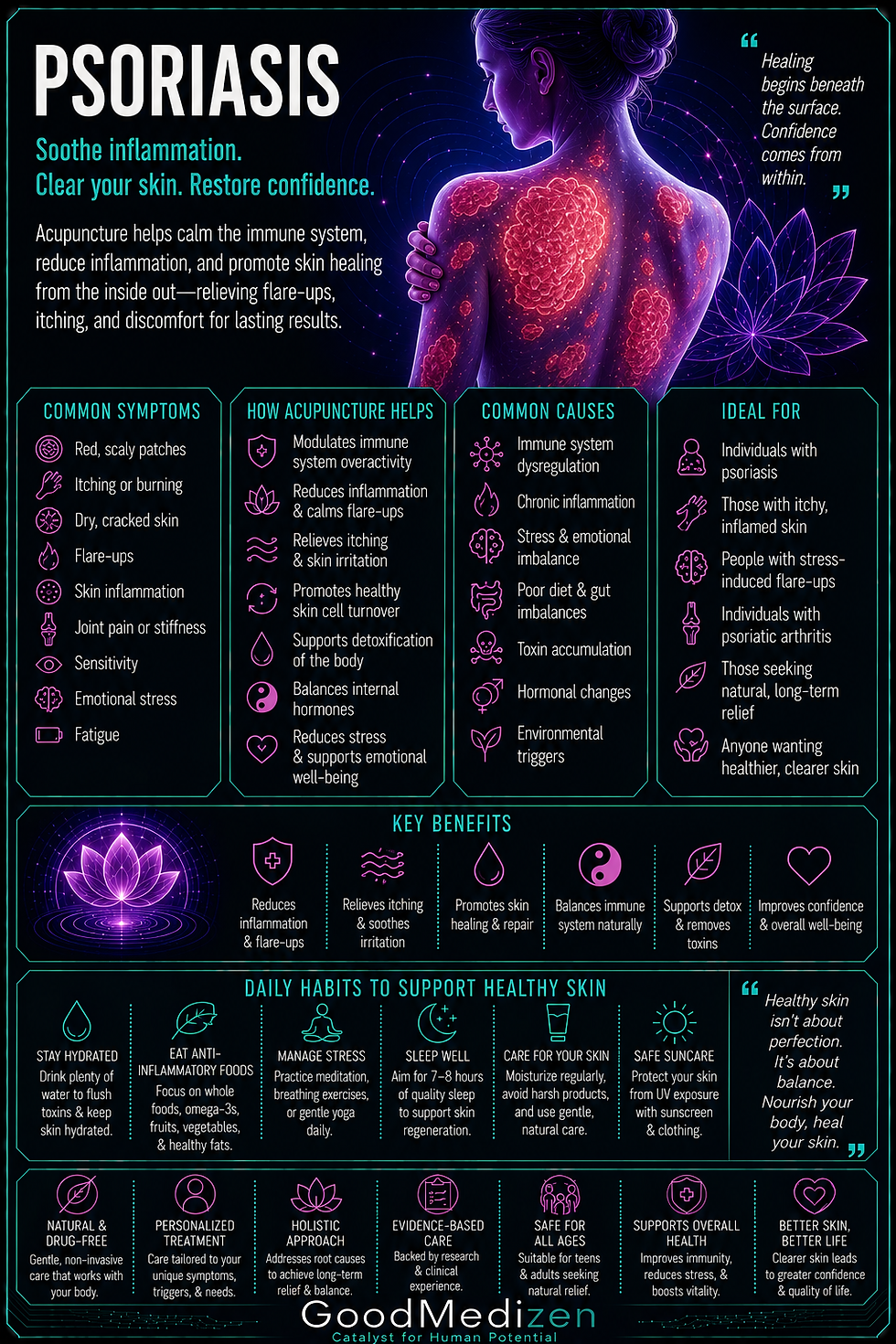
Not Just a Skin Condition
Psoriasis has a reputation as a cosmetic problem — flaky patches, silvery scales, red plaques, difficult to live with but surely skin-deep. It is not. Psoriasis is a systemic inflammatory condition that happens to show prominently on the skin, and people who have it carry a higher risk of cardiovascular disease, metabolic syndrome, inflammatory bowel disease, and psoriatic arthritis. Those are not coincidences; they are the same inflammatory drivers expressing in different tissues. The skin is simply the most visible one. The body is not malfunctioning; it is responding to a system-wide inflammatory signal.
This is the GoodMedizen lens. The body is not malfunctioning. It is responding accurately to the information it is being given. Change the inputs and the response begins to change with them.
What Psoriasis Actually Is
Normal skin cells take about a month to complete their lifecycle. In psoriasis that cycle is compressed to a few days, so cells reach the surface before they have matured, pile up, and form the thick, scaly plaques. Driving it is the immune system: particular T cells become inappropriately activated, infiltrate the skin, and release inflammatory messengers — IL-17, IL-23, TNF-alpha and others — that tell skin cells to multiply and produce inflammation of their own, a self-amplifying loop. The newer biologic medications work by blocking those exact messengers and can produce dramatic results; they also require ongoing use and trade off some immune suppression. The question we add is what activated those T cells, and why the immune system is aiming at the skin.
What Is Actually Driving It
- Gut permeability and dysbiosis — people with psoriasis show distinct microbiome changes, and a leaky barrier feeds the immune system a steady stream of triggers, the gut-skin inflammatory axis
- Molecular mimicry — certain bacterial proteins, particularly from Streptococcus, resemble skin proteins, so an immune response to strep can cross-react with skin; strep is a known trigger for guttate psoriasis
- Metabolic dysfunction — insulin resistance and metabolic syndrome share inflammatory machinery with psoriasis and worsen it
- Chronic stress, a reliable trigger for flares through its inflammatory and immune effects
- Low vitamin D, central to skin-cell regulation and immune balance
Why It Gets Missed
Psoriasis is treated as a skin disease to suppress from the outside, with topicals and, in more severe cases, immune-suppressing systemic drugs, while the systemic drivers — the gut, the metabolic picture, the inflammatory load — go unexamined. Managing the plaques without addressing the inflammation underneath leaves the rest of the risk in place.
Signs and Patterns
- Well-defined red plaques with silvery scale, often on elbows, knees, scalp, or lower back
- Itching or burning at the plaques
- Nail changes such as pitting or separation
- Joint pain or stiffness, a sign of psoriatic arthritis, which needs prompt attention
- Flares after strep infection, stress, or skin injury
- Concurrent metabolic or digestive issues
- Symptoms that wax and wane over time
How We Look at It — The Testing
- Inflammation — hs-CRP, ESR, and a CBC with differential including the neutrophil-to-lymphocyte ratio
- The gut — GI-MAP through Diagnostic Solutions, given the gut-skin axis and the barrier and dysbiosis patterns behind psoriasis
- Metabolic markers — HbA1c, fasting glucose and insulin, the triglyceride-to-HDL ratio, and a lipid panel, since metabolic syndrome and psoriasis travel together
- Vitamin D — 25-OH vitamin D read to an optimal 60 to 70
- The liver and foundations — a comprehensive metabolic panel with GGT, B12 with homocysteine and MMA, and RBC magnesium
- Triggers — assessment for streptococcal involvement where the pattern suggests it
Broad baseline labs do not have to be expensive. Services such as Function Health let patients obtain large workups affordably, and we have no financial stake in that — we would rather your budget go toward care than toward lab markups. For targeted functional testing we order through Diagnostic Solutions (GI-MAP) for the microbiome, Quicksilver Scientific for heavy metals, and through Fullscript where it serves you best, with every marker read against optimal ranges rather than the wide line between “normal” and “abnormal.”
The Chinese Medicine Lens
Chinese medicine reads psoriasis largely as heat in the blood — the redness and rapid skin turnover — frequently with an element of wind behind the itching and spreading and, in chronic cases, blood dryness and stasis as the skin thickens and the plaques entrench. Underneath there is often heat that originated in the gut and the interior. Treatment cools and moves the blood, addresses the wind and dryness, and resolves the interior heat at its source.
The recognition that the skin reflects interior heat, much of it from the digestive core, anticipates the gut-skin axis modern research now describes.
How Acupuncture and Functional Medicine Help
Acupuncture has anti-inflammatory and immune-regulating effects and helps with the stress that reliably triggers flares; it is a support to the deeper work rather than a quick fix for plaques.
The functional work targets the drivers: healing the gut barrier and rebalancing the microbiome, addressing the metabolic picture, correcting vitamin D, lowering the inflammatory and stress load, and identifying triggers such as strep. The aim is fewer and milder flares and a lower whole-body inflammatory burden — which matters for the heart and joints, not only the skin.
Care That Works With Your Dermatologist
Psoriasis, and especially psoriatic arthritis, benefits from medical management, and the modern biologics can be genuinely effective; joint symptoms in particular need prompt evaluation to protect the joints. We work alongside your dermatologist and rheumatologist, never instead of them, and we never advise stopping a prescribed medication. Our role is to lower the inflammation feeding the whole picture.
Your Body Isn’t Broken
If you have spent years being told your labs look normal while you clearly do not feel normal, you have not been imagining it. With psoriasis, the work is to calm the systemic inflammation driving it, so the skin — and the heart, joints, and gut along with it — carry a lighter load. Your body is not broken. The support has just been missing.
At GoodMedizen in downtown Seattle, we treat the system driving the condition, not only the symptoms it produces.