.png)
catalyst for human potential
downtown seattle's home for personalized, integrative care: acupuncture, herbs, and functional medicine
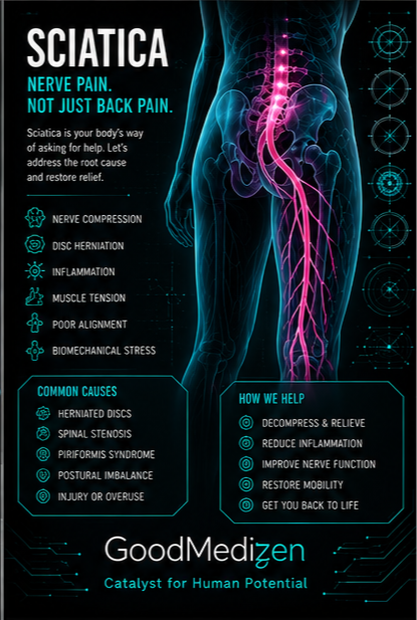
When Your Leg Pain Isn't Actually a Leg Problem
Most people who come in thinking they have sciatica don't actually have sciatica.
They've been told they do — by a doctor, a chiropractor, or Dr. Google — and the label fits well enough that nobody questions it. Pain down the back of the leg, maybe into the calf or foot. Sounds like sciatica. The sciatic nerve can be irritated in several different places, though, and true nerve root compression at the lumbar spine is just one of them. Piriformis syndrome — where a deep gluteal muscle compresses the sciatic nerve in the pelvis — is frequently the actual culprit, and it won't show up on a spinal MRI.
The distinction matters because depending on where you seek treatment and what tools your practitioner has available, the approach can be completely different — and if the wrong structure is being targeted, relief is going to be incomplete at best.
What Sciatica Actually Is
The sciatic nerve is formed by nerve roots exiting the spine at levels L4, L5, S1, S2, and S3. These roots merge into a single large nerve that travels through the pelvis, passes under (and sometimes through) the piriformis muscle deep in the buttock, runs down the back of the thigh, and eventually branches into the tibial and common peroneal nerves that supply the lower leg and foot.
Any point along that path where the nerve gets compressed or irritated can produce the classic sciatica presentation: radiating pain, numbness, tingling, burning, or weakness that follows the nerve's distribution. The specific location of the compression determines where symptoms appear.
Conventional imaging will usually look at one thing — is there disc herniation or stenosis at the lumbar spine? That's an important question. It's not the only question, and it's not always the right question. The sciatic nerve can be irritated in multiple places, often simultaneously, and imaging of the spine doesn't catch what's happening in the pelvis and glutes.
The Different Places Sciatic Nerve Compression Happens
Lumbar disc herniation. When a disc between the vertebrae bulges or ruptures, the inner nucleus can press on the nerve root as it exits the spine. The compression irritates the nerve root itself, producing radicular pain — sharp, electric, following the specific dermatome supplied by that nerve root. L5 radiculopathy tends to produce pain down the outer thigh into the top of the foot and big toe. S1 radiculopathy produces pain down the back of the leg into the heel and outer foot.
Lumbar spinal stenosis. Narrowing of the spinal canal or the foramina — whether from degenerative changes, congenital factors, or other causes — can compress nerves without any acute disc injury. Stenotic pain tends to worsen with standing or walking and improve with sitting or leaning forward, because forward flexion opens the stenotic space slightly.
Piriformis syndrome. The piriformis is a deep muscle in the buttock that runs horizontally across the pelvis. The sciatic nerve passes directly underneath it — and in about 15-20% of people, the nerve actually runs through the muscle rather than under it (a normal anatomical variant). When the piriformis becomes tight, inflamed, or develops trigger points, it can compress the sciatic nerve against the pelvic bone. This is a common cause of sciatica that doesn't show up on spinal imaging at all — because the problem isn't at the spine.
Sacroiliac joint dysfunction. The SI joint, where the sacrum meets the pelvis, can become inflamed, hypermobile, or stuck. Dysfunction here refers pain into the glute and leg in patterns that mimic sciatica and can also directly irritate nerve roots exiting nearby.
Gluteal and deep hip trigger points. Beyond the piriformis, other deep hip rotators — the obturator internus, superior and inferior gemelli, quadratus femoris — can develop trigger points that refer pain down the leg in sciatic patterns. Gluteus medius trigger points are particularly notorious for creating pain that feels exactly like classical sciatica.
Quadratus lumborum and compensatory patterns. When something in the lower back or pelvis isn't moving correctly, surrounding muscles take on more load than they're designed for. Chronically overloaded muscles develop trigger points and hypertonicity that can compress nerves, pull joints out of alignment, and create secondary pain patterns that radiate into the sciatic distribution.
Most cases of sciatica we see involve more than one of these at once. Treatment that addresses only one component produces partial results.
How We Treat Sciatica at GoodMedizen
At GoodMedizen, we treat musculoskeletal conditions like sciatica using our proprietary system — Tissue Response Assessment and Corrective Strategy, or TRACS. This approach integrates the needling of myofascial trigger points with careful attention to timing, sequence, and related structures to create a comprehensive treatment protocol that delivers more effective and longer-lasting results than standard acupuncture protocols alone.
We don't just needle the back. We evaluate the whole kinetic chain — spine, sacrum, pelvis, deep hip rotators, glutes, quadratus lumborum, hamstrings — identify which specific tissues are holding the compression or compensation, and treat them in an order that allows the system to unwind rather than just temporarily quiet down.
Alongside TRACS, we use:
Traditional acupuncture for pain modulation and inflammation reduction. Acupuncture has a well-documented effect on the descending pain inhibitory pathways — it stimulates the release of endogenous opioids (beta-endorphin, enkephalin) and engages the periaqueductal gray in the midbrain, the body's own natural pain-dampening system. For acute sciatica, we can significantly reduce pain signal transmission while the underlying tissue heals.
Electroacupuncture when appropriate. Running low-frequency electrical current through needles placed at specific points enhances the analgesic effect and increases blood flow to the treated tissues. Particularly useful for stubborn cases where trigger points are chronic and deep.
Point Injection Therapy (PIT) is one of the more powerful tools we have for stubborn musculoskeletal cases. Rather than pharmaceutical steroids — which come with a well-documented list of side effects including tissue damage, tendon weakening, bone thinning, and blood sugar elevation — we inject therapeutic compounds directly into acupuncture points and trigger points. Our injectable toolkit includes:
Homeopathic Traumeel — a botanical anti-inflammatory compound that has demonstrated comparable effectiveness to NSAIDs for reducing pain, swelling, and inflammation, with a significantly better safety profile (Schneider, 2011)
Homeopathic Zeel — plant extracts that stimulate growth factor release, protect cartilage, and promote tissue regeneration; particularly useful in degenerative conditions
Spascupreel — homeopathic formula for muscle spasm and cramping patterns
Gelsemium — homeopathic compound for nerve pain patterns
Procaine — restores normal nerve membrane potential and can deactivate trigger points directly
Lidocaine — local anesthetic with documented ability to break trigger point activity and reduce neurogenic inflammation
Methylcobalamin and Hydroxocobalamin (B12) — active forms of B12 that support nerve repair and myelin regeneration; particularly relevant when nerve involvement is part of the picture
Sarapin — an FDA-approved, AMA-recognized botanical compound derived from pitcher plant, used for over 70 years for a range of pain presentations
Peptide therapy for appropriate cases — particularly traumatic injuries and significant nerve involvement. BPC-157 and TB-500 have emerging research supporting tissue repair, tendon and ligament healing, and anti-inflammatory effects. KPV, a melanocortin-derived peptide, is used when nerve involvement and neuroinflammation are part of the picture.
Cupping and gua sha to address fascial restrictions and improve circulation to ischemic muscle tissue.
Chinese herbal medicine to support tissue repair, reduce inflammation systemically, and address underlying patterns — blood deficiency, dampness accumulation, or kidney yang deficiency, which in TCM correlates with the structural integrity of the lumbar spine and knees.
Functional assessment of movement patterns, daily habits, and contributors that most people don't connect to their sciatica: sitting posture, asymmetric loading, old injuries that changed how you move, core weakness, hip mobility limitations. These are often what keeps sciatica coming back even after pain initially resolves.
Where TCM Comes In
Chinese medicine has been treating what we now call sciatica for thousands of years, under descriptions like bi syndrome (obstruction pattern) and specific pain patterns along the Bladder and Gallbladder meridians — which run almost exactly along the paths of the sciatic nerve's major branches.
Qi and Blood Stagnation in the Bladder channel. Sharp, fixed, stabbing pain that worsens with cold or damp. Corresponds to acute inflammation and impaired circulation at the nerve root or along the nerve's path.
Damp-Cold Obstruction. Heavy, aching, deep pain that feels worse in cold or damp conditions and improves with warmth. Tracks with chronic inflammatory patterns where circulation is compromised and tissue is under-perfused.
Kidney Deficiency with Bi Syndrome. Chronic, recurring low back and leg pain, often with knee weakness, fatigue, and history of overwork or long-standing strain. Corresponds to degenerative changes and the kind of long-term patterns that make people susceptible to repeated flares.
The TCM pattern tells us about the quality of the problem — acute vs chronic, hot vs cold, excess vs deficiency — which informs everything from point selection to herbal formulation to how aggressive treatment can be.
When to Consider Us
You've been dealing with sciatic-pattern pain for weeks or months and it isn't resolving
Your MRI showed disc issues but treatment focused on the disc hasn't fully resolved your symptoms
Your MRI was clean but you still have classic sciatica symptoms
Physical therapy helped but pain returns whenever you stop
You're trying to avoid surgery and want to see if conservative, integrated treatment can resolve it
Your pain is worse with sitting, driving, or specific positions
You had a spinal procedure that helped initially but symptoms have returned
You're dealing with a flare after a specific incident — fall, pregnancy, new exercise routine, prolonged travel
Selected References
Qin, Z., et al. (2015). Acupuncture for chronic low back pain: A meta-analysis. Am J Chin Med, 43(8), 1543–1559.
Lee, J. H., et al. (2013). Acupuncture for acute low back pain: A systematic review. Clin J Pain, 29(2), 172–185.
Travell, J. G., & Simons, D. G. (1999). Myofascial Pain and Dysfunction: The Trigger Point Manual. Lippincott.
Smith, C. A., et al. (2015). Acupuncture to treat sciatica: A systematic review. ECAM, 2015.
Schneider, C. (2011). Traumeel: An emerging option to NSAIDs in acute musculoskeletal injuries. PMC 3085232.