.png)
catalyst for human potential
downtown seattle's home for personalized, integrative care: acupuncture, herbs, and functional medicine
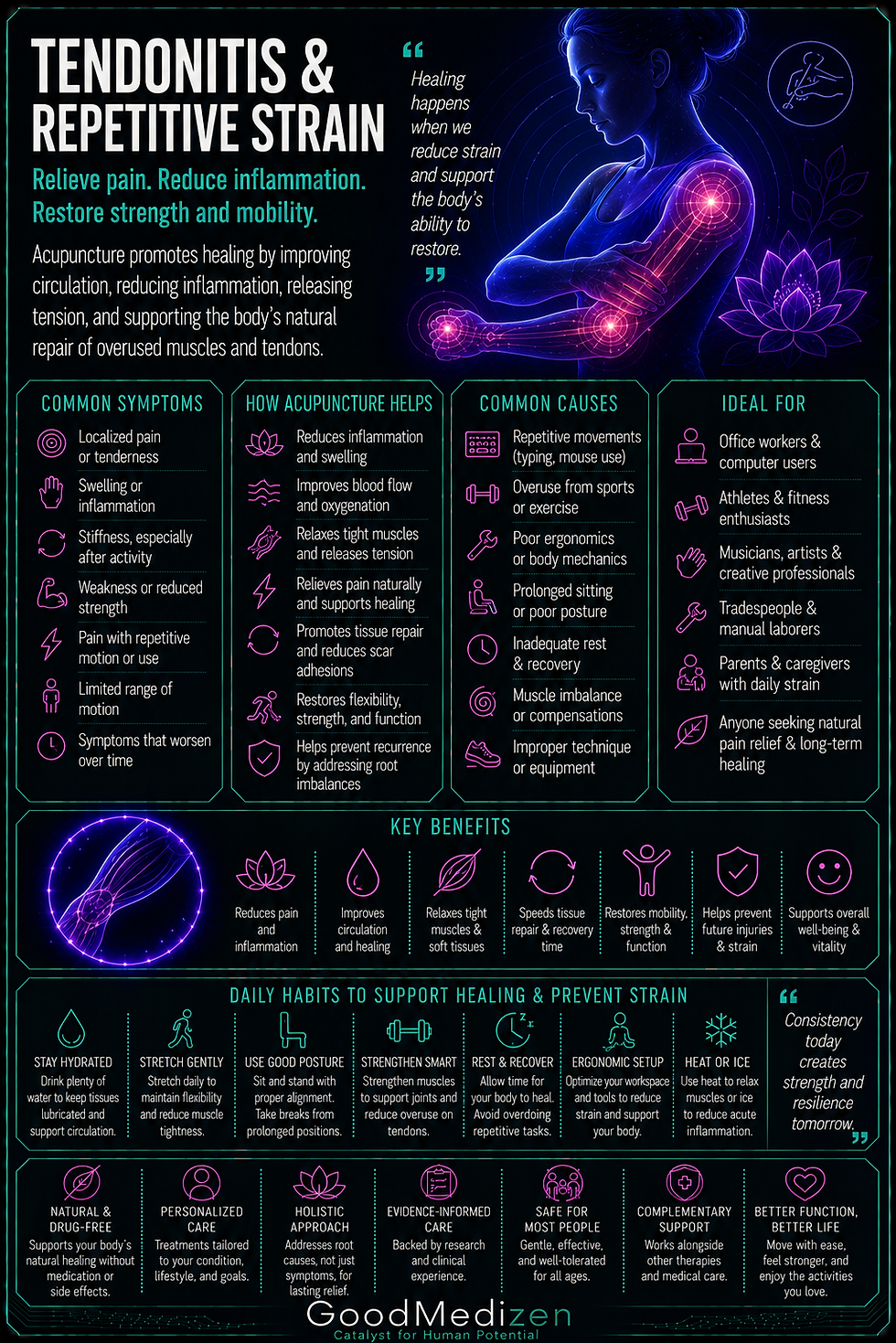
Tendonitis and Repetitive Strain
Resolve tendonitis, repetitive strain injuries, and overuse conditions with acupuncture.
Most Chronic "Tendonitis" Isn't Actually Tendonitis
That's not wordplay. It's one of the more significant shifts in sports medicine research over the last two decades, and it has real implications for how tendon pain should be treated.
"Tendonitis" means inflammation of the tendon. Acute tendonitis — the first few days after you overuse a tendon or injure it — is genuinely inflammatory. There are inflammatory cells, inflammatory signaling, and the standard anti-inflammatory strategies work on it.
Once tendon pain persists past a few weeks, the picture changes. Biopsies of chronically painful tendons show minimal inflammation. What they show instead is disorganized collagen, failed healing tissue, increased ground substance, and neovascularization — the hallmarks of a degenerative process, not an inflammatory one. The updated term for this is tendinopathy or tendinosis. Chronic Achilles pain, chronic tennis elbow, chronic rotator cuff pain, chronic patellar pain — the research now classifies these as degenerative conditions, not inflammatory ones (Scott et al., 2019).
This matters because it explains the clinical pattern so many patients get stuck in: NSAIDs didn't help, rest only worked until they started using the arm or knee or shoulder again, and the cortisone injection felt great for six weeks before the pain came back worse. None of those treatments address a degenerative tendon. NSAIDs can actually impair collagen synthesis. Cortisone injections, while they quiet pain short-term, have been shown in long-term studies to produce worse outcomes than no treatment at all for chronic tendinopathy (Coombes et al., 2010). The tendon needs the opposite: a stimulus that drives it to reorganize its collagen, rebuild its structure, and restore its ability to handle load.
What's Actually Happening in a Painful Tendon
Tendons are dense, ordered bundles of collagen designed to transmit force from muscle to bone. Under microscopy, they're supposed to look like a tightly braided rope — parallel, uniform, structurally organized. That organization is what gives them their tensile strength.
Repetitive loading that exceeds the tendon's repair capacity creates microtears in the collagen matrix. If the tissue has time to repair between loads, the collagen rebuilds in the correct organized pattern and the tendon gets stronger — this is how training adaptation works. If the loading keeps happening without adequate recovery, the repair process fails. The body lays down new collagen, but in a disorganized way. New blood vessels and nerve endings grow into areas they don't normally occupy (neovascularization and neoinnervation) — which explains both the chronic pain and the fact that the tendon feels structurally different on exam.
At that point, the tendon has lost its ability to handle the loads it used to handle. Every time the patient tries to use it, they re-injure the already-failing tissue. Rest helps short-term because there's no new damage, but it doesn't rebuild what's been lost. The only thing that rebuilds a chronically damaged tendon is progressive loading that signals the collagen-producing cells (tenocytes) to lay down new, organized tissue.
Sites where we see tendinopathy in the clinic:
- Rotator cuff tendinopathy (especially supraspinatus) — shoulder pain with overhead motion
- Lateral epicondylitis (tennis elbow) — outside of the elbow, worse with gripping
- Medial epicondylitis (golfer's elbow) — inside of the elbow
- Achilles tendinopathy — back of the ankle, worse with running and stairs
- Patellar tendinopathy (jumper's knee) — below the kneecap, worse with squatting and jumping
- Gluteal tendinopathy — lateral hip, worse with stairs and side-lying
- De Quervain's tenosynovitis — thumb-side of the wrist, worse with gripping and lifting
- Plantar fasciopathy — heel pain, worse with first steps in the morning
Where Tendinopathy Actually Comes From
Training errors and load management. Sudden increases in volume or intensity without enough recovery. A weekend warrior going hard on Saturday after five sedentary days. A desk worker picking up a new sport and ramping too fast. The tendon gets hit with loads it isn't conditioned for, and the repair process can't keep up.
Movement chain dysfunction. This is what we find driving chronic tendinopathy over and over in clinic. A weak glute medius forces the IT band to overwork, loading the lateral hip and knee abnormally. Poor scapular control loads the rotator cuff tendons beyond what they're designed for. A restricted hip forces the low back or knee to compensate. The tendon that ends up painful often isn't the one that's "weak" — it's the one stuck compensating for something else.
Systemic factors that affect collagen quality. Elevated blood sugar glycates collagen, making it stiffer and more prone to injury. Metabolic syndrome and insulin resistance impair tissue repair. Chronic inflammation from any source slows tendon healing. Hypothyroidism alters collagen metabolism and tendon properties.
Nutrient deficiencies that affect tendon repair. Vitamin C is required for collagen synthesis. Protein adequacy (especially leucine-rich sources) drives tissue repair. Copper is a cofactor for lysyl oxidase, the enzyme that cross-links collagen. Vitamin D status correlates with tendon healing speed.
Hormonal factors. Estrogen significantly affects tendon mechanics and injury risk. Drops during perimenopause and menopause can shift tendon mechanics and slow healing. Testosterone status affects tendon health in men. Oral contraceptives can alter tendon properties in some women.
Medications that impair tendon integrity. Fluoroquinolone antibiotics (ciprofloxacin, levofloxacin) carry a documented risk of tendon rupture — sometimes triggered weeks after the course finishes — significant enough that the FDA has issued a black box warning. Corticosteroid injections, as mentioned, weaken tendon structure with repeated use. Statins have been implicated in some tendon issues, though the evidence there is less established.
Age-related collagen changes. Tendon collagen turnover slows with age, making recovery from overload more difficult. The practical implication: what worked in your twenties — push through, rest, repeat — doesn't work the same way in your forties and fifties. Training and recovery strategies have to adapt.
Where TCM Comes In
In Chinese medicine, the Liver governs the tendons and sinews. This isn't about the anatomical liver organ — it's about the function of providing nourishment and smooth flow of qi and blood to the connective tissue. When Liver blood is deficient, tendons become brittle and injury-prone. When qi stagnates in a channel, the tendons and muscles within that channel become painful and restricted.
Qi and Blood Stagnation in the Channel — sharp, fixed pain in a specific area, worse with pressure, typically following trauma or overuse. The typical pattern in acute tendon injuries.
Liver Blood Deficiency — chronic tendon issues with stiffness, easy reinjury, slow healing, often with associated signs like brittle nails, dry skin, and poor sleep. Corresponds to the chronic tendinopathy pattern where the tissue just can't seem to repair.
Kidney Deficiency — chronic tendon degeneration in older patients, often with constitutional signs (low back weakness, knee weakness, fatigue). Corresponds to the age-related collagen decline that makes recovery harder.
Damp-Heat — the acute inflammatory phase, red/warm/swollen presentations that respond to cooling and anti-inflammatory strategies.
The TCM pattern shapes the herbal and treatment strategy: blood-moving formulas for acute injury, Liver-nourishing formulas for chronic presentations with brittle tissue, Kidney-tonifying formulas for deep constitutional patterns, and damp-heat-clearing formulas for acute inflammatory flares.
How We Treat Tendinopathy at GoodMedizen
At GoodMedizen, we treat musculoskeletal conditions using our proprietary system — Tissue Response Assessment and Corrective Strategy, or TRACS. This approach integrates the needling of myofascial trigger points with careful attention to timing, sequence, and related structures to create a comprehensive treatment protocol that delivers more effective and longer-lasting results than standard acupuncture protocols alone.
For tendinopathy specifically, TRACS matters because the damaged tendon is almost always the downstream result of something upstream. Treating only the painful tendon ignores the movement chain dysfunction that caused the overload in the first place. TRACS addresses the muscles and trigger points in the entire relevant chain — which is why our patients get results on tendon problems that didn't respond to conventional PT alone.
Alongside TRACS, we use:
Traditional acupuncture reduces pain, improves local circulation to the chronically under-perfused tendon, and stimulates the body's repair processes. For acute tendon injury, acupuncture often provides significant in-session relief. For chronic tendinopathy, it supports the longer rebuilding process.
Electroacupuncture is one of the better-researched interventions for tendinopathy specifically. Low-frequency electrical stimulation appears to enhance collagen reorganization and tendon repair processes. For chronic tendons where structural rebuilding is needed, this is a core part of the treatment.
Point Injection Therapy (PIT) is particularly valuable for tendinopathy because it delivers anti-inflammatory and tissue-supportive compounds locally without the collagen-weakening effects of cortisone. Our injectable toolkit includes:
- Homeopathic Traumeel — botanical anti-inflammatory with comparable effectiveness to NSAIDs for musculoskeletal injuries, significantly better safety profile, no collagen-impairing effects (Schneider, 2011)
- Homeopathic Zeel — growth factor release, connective tissue support, tissue regeneration
- Procaine and Lidocaine — local anesthetics that deactivate the trigger points driving tendon overload
- Methylcobalamin and Hydroxocobalamin (B12) — for nerve-irritation components (often relevant in De Quervain's and carpal tunnel patterns)
- Sarapin — FDA-approved botanical compound with a 70+ year history in pain medicine
- Spascupreel — for the accompanying muscle spasm in the compensation chain
Peptide therapy is particularly evidence-aligned for tendon rebuilding. BPC-157 has preclinical research supporting accelerated tendon-to-bone healing and enhanced tendon repair. TB-500 supports cellular migration and tissue regeneration. For chronic tendinopathy that's stalled, peptides can be a meaningful addition to the treatment plan.
Cupping and gua sha to address the fascial restrictions and scar tissue patterns that accumulate around chronically dysfunctional tendons, and to improve blood flow to tissues with compromised circulation.
Chinese herbal medicine tailored to the pattern — blood-moving formulas for acute injury, Liver-nourishing formulas for chronic brittle-tissue presentations, Kidney-tonifying formulas for age-related degeneration.
Functional movement assessment and progressive loading. This is non-optional for chronic tendinopathy. The tendon has to be loaded for it to rebuild, and loaded correctly. Eccentric and heavy slow resistance protocols have the best research evidence for chronic tendinopathies — the Alfredson protocol for Achilles, heavy slow resistance for patellar tendinopathy, progressive loading for rotator cuff. We integrate these protocols into the treatment plan and coordinate with physical therapy where appropriate.
Functional medicine. For patients with recurrent or multi-site tendinopathy, we assess metabolic markers (HbA1c, fasting insulin), thyroid function, vitamin D, and nutrient status relevant to collagen synthesis. Correcting the systemic factors that impair tendon repair often changes the trajectory of the recovery.
Lifestyle integration. Adequate protein intake, vitamin C, collagen peptide supplementation (emerging evidence for tendon repair), load management, and sleep optimization. The tendon can't rebuild what it doesn't have the raw materials or recovery to produce.
When to Consider Us
- You have chronic tendon pain that hasn't responded to rest, NSAIDs, or PT
- You've been told you need a cortisone injection and want to avoid it
- You had a cortisone injection that helped short-term but the pain returned
- You have recurrent tendon problems at the same site or multiple sites
- You're an athlete trying to return to full performance
- You're a desk worker with chronic tennis elbow, wrist, or shoulder issues
- You've been told surgery is the next step and want to explore alternatives first
- You want to understand why this tendon keeps getting injured and fix the underlying pattern
Selected References
- Coombes, B. K., et al. (2010). Efficacy and safety of corticosteroid injections and other injections for management of tendinopathy: a systematic review of randomised controlled trials. Lancet, 376(9754), 1751–1767.
- Scott, A., et al. (2019). ICON 2019: International Scientific Tendinopathy Symposium Consensus. Br J Sports Med, 54(5), 260–262.
- Alfredson, H., et al. (1998). Heavy-load eccentric calf muscle training for the treatment of chronic Achilles tendinosis. Am J Sports Med, 26(3), 360–366.
- Schneider, C. (2011). Traumeel: An emerging option to NSAIDs in acute musculoskeletal injuries. Int J Gen Med, 4, 225–234. PMC 3085232.
- Neal, B. S., et al. (2015). Electroacupuncture for tendinopathy: a systematic review. Acupunct Med, 33(2), 82–87.
- Chang, C. H., et al. (2014). The promoting effect of pentadecapeptide BPC 157 on tendon healing. J Appl Physiol, 117(6), 640–648.