.png)
catalyst for human potential
downtown seattle's home for personalized, integrative care: acupuncture, herbs, and functional medicine
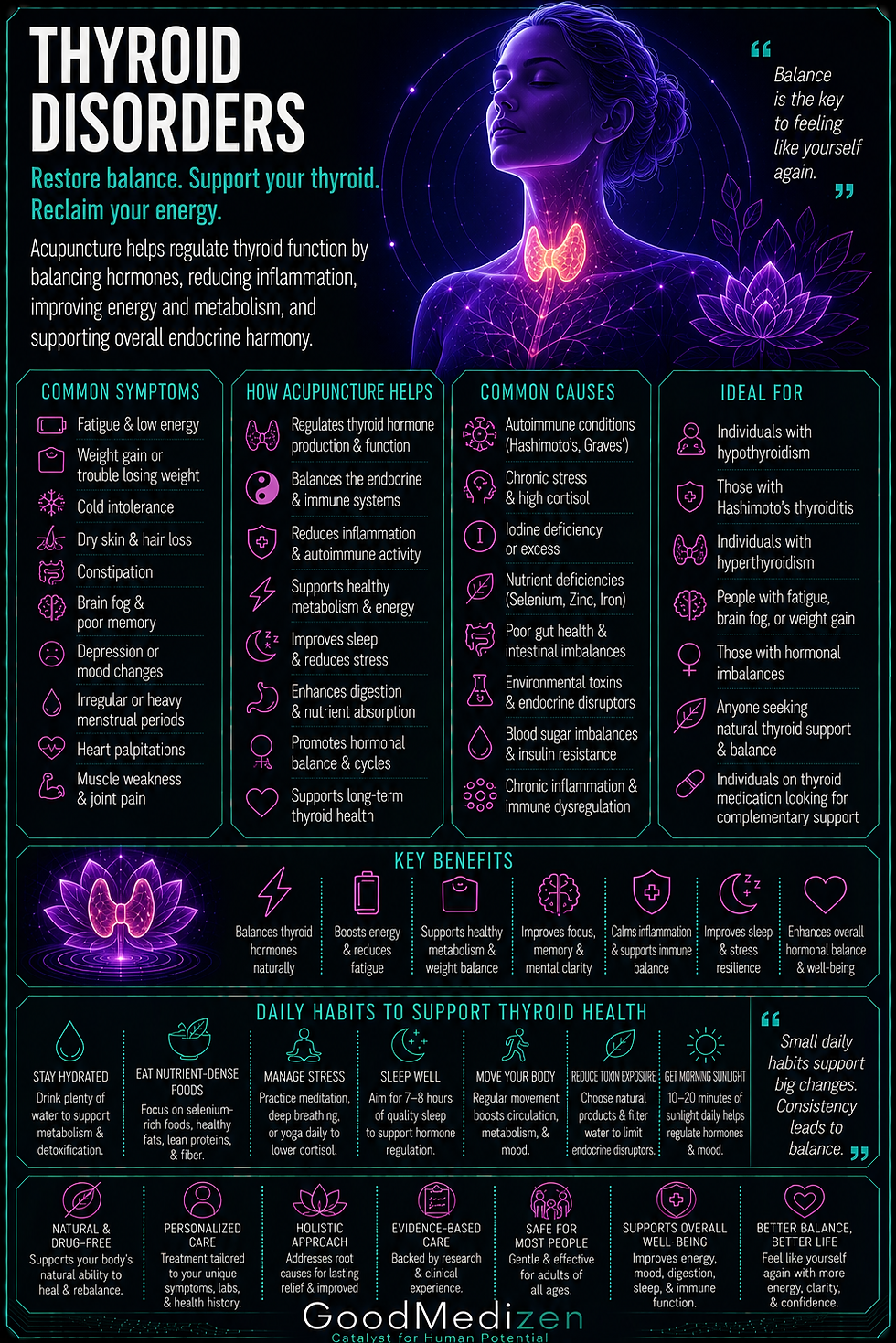
Your Thyroid Is Probably Doing More Than Your Labs Suggest — In Either Direction
If you've been told your thyroid is fine because your TSH is in range, but you have every classic hypothyroid symptom — fatigue, weight gain, cold intolerance, brain fog, hair thinning, dry skin, depression, constipation — you've encountered the limits of standard thyroid screening. The thyroid story is more complex than TSH alone, and a substantial number of people with real thyroid dysfunction are missed by conventional testing.
On the other end, if you have an existing thyroid diagnosis (Hashimoto's, Graves', hypo- or hyperthyroidism) and you're medicated to a "normal" TSH but still don't feel right — you also have company. Hashimoto's affects far more than thyroid hormone production. The autoimmune attack on the thyroid drives broader immune dysregulation, gut symptoms, and other autoimmune conditions. Treating the TSH without addressing the autoimmunity treats the marker, not the disease.
Either way — missed dysfunction or partially-treated disease — there's substantial room for the integrative approach that combines comprehensive testing, addressing root drivers, and pattern-based herbal medicine alongside conventional thyroid management when needed.
What's Actually Happening in Thyroid Dysfunction
The thyroid produces two main hormones: T4 (thyroxine, mostly inactive storage form) and T3 (triiodothyronine, the active form). T4 must be converted to T3 in peripheral tissues — primarily the liver, kidney, and gut — to actually do its work. The pituitary releases TSH (thyroid stimulating hormone) to drive thyroid production; high TSH signals the thyroid is underproducing, low TSH that it's overproducing.
The complete picture requires:
TSH. Standard screening. Useful but insufficient alone. The conventional reference range (typically 0.5-4.5) is broader than optimal — many people with TSH in the 2.5-4.5 range have symptomatic thyroid dysfunction.
Free T4. Available T4 not bound to carrier proteins. The form that can actually be used.
Free T3. The active hormone. This is what tissues actually respond to. Free T3 can be low even with normal TSH and T4 — typically due to impaired conversion.
Reverse T3. An inactive metabolite that competes with T3 at receptor sites. Elevated reverse T3 essentially blocks thyroid action even when other levels look adequate. Driven by stress, inflammation, low calorie intake, illness, and certain medications.
TPO and Thyroglobulin antibodies. Elevated antibodies indicate autoimmune thyroid disease — Hashimoto's (the more common, leading to hypothyroidism) or Graves' (hyperthyroidism). Antibodies can be elevated for years before TSH becomes abnormal, with significant symptoms.
TSI and TBII antibodies. Specific to Graves' disease.
Several mechanisms can disrupt this system:
Hashimoto's autoimmune disease. The most common cause of hypothyroidism in the United States. The immune system mounts an attack on the thyroid that gradually destroys tissue. Identifying it early matters — addressing the autoimmune drivers (gut, inflammation, food triggers, latent infections like EBV) can slow or halt progression.
Graves' disease. Antibodies stimulate the thyroid to overproduce, causing hyperthyroidism. Symptoms include weight loss, anxiety, palpitations, heat intolerance, tremor. Conventional treatment is anti-thyroid medication, radioactive iodine, or surgery; integrative care addresses the autoimmune drivers that are also part of the picture.
Conversion problems. When T4-to-T3 conversion is impaired, free T3 stays low even with adequate T4. Driven by chronic stress, inflammation, gut dysfunction, selenium or zinc deficiency, certain medications, and elevated reverse T3.
Reverse T3 dominance. Body in conservation mode shunts T4 toward reverse T3 instead of active T3. Common after major stressors, prolonged illness, low-calorie diets, or chronic inflammation.
Cellular thyroid resistance. Thyroid hormones can be present but not effectively used at the cellular level. Less commonly identified but real, often related to inflammation and metabolic dysfunction.
Iodine status complexity. Iodine is required for thyroid hormone production but is one of the most controversial nutrients in thyroid care. Excess iodine can drive autoimmune thyroid worse in susceptible patients. Selenium status modulates iodine handling.
Postpartum thyroiditis. Roughly 5-10% of women develop transient or persistent thyroid dysfunction in the year after childbirth. Often missed.
What Drives Autoimmune Thyroid
Gluten and food triggers. The connection between gluten and Hashimoto's is well-documented. Gluten elimination reduces antibody levels in many patients. Other food sensitivities, dairy in particular, contribute in subsets of patients.
Gut permeability and dysbiosis. The gut-thyroid connection is direct. Intestinal permeability allows antigenic translocation that drives systemic immune activation — a foundation for autoimmunity.
EBV and other latent viruses. Multiple studies have identified EBV in thyroid tissue of Hashimoto's patients, supporting the role of latent viral infection in autoimmune thyroid pathogenesis.
Toxic burden. Heavy metals (especially mercury), endocrine-disrupting chemicals, and mold biotoxins all affect thyroid function and can drive autoimmunity.
Stress and HPA dysregulation. Chronic cortisol disruption directly impairs thyroid function and conversion.
Nutrient deficiencies. Selenium (critical for conversion and antioxidant protection), zinc, iron, vitamin D, and B12 all affect thyroid function. Iodine is a careful balance.
Hormonal transitions. Pregnancy, postpartum, and perimenopause are common windows for thyroid disorders to emerge.
Where TCM Comes In
Chinese medicine has frameworks that map onto thyroid patterns clinically.
Kidney Yang Deficiency. Cold intolerance, fatigue, low motivation, weight gain, slow digestion, hair thinning. Maps onto hypothyroid presentations. Treatment warms and tonifies kidney yang.
Spleen Qi Deficiency. Fatigue, digestive issues, weight changes, brain fog. Common in hypothyroid pictures. Treatment tonifies the spleen.
Heart Yin Deficiency with Empty Heat. Anxiety, palpitations, insomnia, heat intolerance, restlessness. Maps onto hyperthyroid presentations. Treatment nourishes yin and clears empty heat.
Liver Qi Stagnation transforming to Heat. Stress-driven thyroid flares, irritability, hyperthyroid presentations with prominent emotional component.
Phlegm-Damp accumulation in the neck. Goiter, nodules, swelling. Treatment transforms phlegm and softens hardness.
Liver Blood Deficiency. Hair loss, dryness, brittle nails, fatigue — typical thyroid-related findings.
How We Approach Thyroid Disorders
Comprehensive testing. Full panel: TSH, free T4, free T3, reverse T3, TPO antibodies, thyroglobulin antibodies. Add TSI/TBII when Graves' is suspected. Comprehensive supporting tests: vitamin D, B12 and methylation, ferritin, selenium and zinc status, gut function evaluation, EBV serology when autoimmunity is present.
Coordinate with conventional care. When thyroid medication is needed, we encourage appropriate prescribing. We help patients work with their physicians to consider T3-containing options (Cytomel, Armour, NDT) when T4-only treatment isn't producing adequate symptom resolution. We don't prescribe thyroid medication ourselves.
Acupuncture supports thyroid function, improves circulation, modulates immune activity, and addresses the TCM pattern. Specific protocols address goiter and nodules, fatigue, anxiety in hyperthyroid patterns, and the systemic depletion in chronic hypothyroidism.
Chinese herbal medicine is one of the strongest tools for thyroid pattern work. Pattern-matched formulas warm yang, nourish yin, transform phlegm, soothe the liver, and support kidney function. Selection requires expertise — some herbs are inappropriate in autoimmune thyroid or with thyroid medications.
Address autoimmune drivers. When Hashimoto's or Graves' is part of the picture: gut healing, gluten elimination (essential), food trigger identification, EBV and other latent infections where indicated, toxin burden assessment, stress regulation. This is where the long-term work lives.
Targeted nutritional support. Selenium (especially for conversion and Hashimoto's antibody reduction), vitamin D to optimal levels, methylated B-complex, zinc, iron if deficient, magnesium, omega-3s. Iodine carefully and only when indicated by testing in the right pattern.
Lifestyle integration. Stress regulation, adequate sleep, blood sugar stability, appropriate movement (avoiding overtraining which worsens thyroid function), strength training. Removing endocrine disruptors where possible (BPA-free containers, fluoride-free water, fragrance-free products).
When to Consider Us
- You have classic thyroid symptoms but your TSH is in range
- You have Hashimoto's and want to address the autoimmune drivers, not just take Synthroid
- You have Graves' and want comprehensive support alongside endocrine care
- You're on T4 (Synthroid, levothyroxine) and still don't feel right
- You have hyperthyroid symptoms (anxiety, palpitations, weight loss, tremor) needing evaluation
- You have a thyroid nodule or goiter and want pattern-based support
- You're newly postpartum and have thyroid-like symptoms
- You have multiple autoimmune conditions including thyroid
- You want a workup for the upstream drivers — gut, EBV, toxins, stress — that affect thyroid function
Selected References
- Garber, J. R., et al. (2012). Clinical practice guidelines for hypothyroidism in adults. Thyroid, 22(12), 1200–1235.
- Krysiak, R., et al. (2019). The effect of gluten-free diet on thyroid autoimmunity in drug-naïve women with Hashimoto's thyroiditis. Exp Clin Endocrinol Diabetes, 127(7), 417–422.
- Toulis, K. A., et al. (2010). Selenium supplementation in the treatment of Hashimoto's thyroiditis: A systematic review and a meta-analysis. Thyroid, 20(10), 1163–1173.
- Janegova, A., et al. (2015). Rola infekcji wirusem Epsteina-Barr w rozwoju autoimmunologicznych chorób tarczycy. Endokrynol Pol, 66(2), 132–136.
- Wiersinga, W. M. (2014). Paradigm shifts in thyroid hormone replacement therapies for hypothyroidism. Nat Rev Endocrinol, 10(3), 164–174.
- Pearce, E. N., et al. (2013). Iodine nutrition: From the trace elements to the thyroid hormone. Best Pract Res Clin Endocrinol Metab, 27(6), 745–755.