.png)
catalyst for human potential
downtown seattle's home for personalized, integrative care: acupuncture, herbs, and functional medicine
OCD and Intrusive Thoughts
Adjunct support for OCD, compulsive behaviors, and intrusive thought patterns.
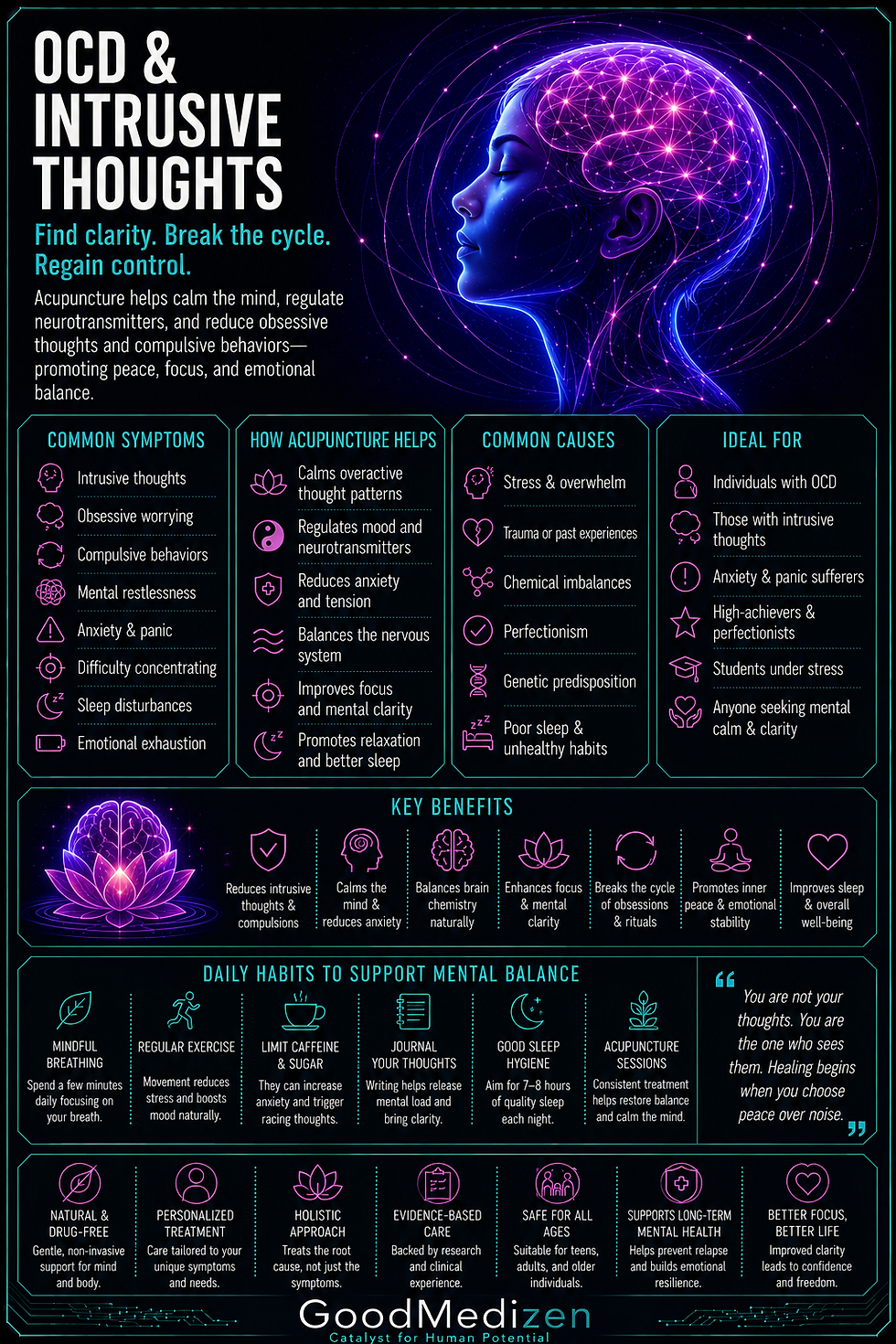
When the Mind Won’t Let Go
Obsessive-compulsive disorder is far more than tidiness or a preference for order. It is a genuinely distressing cycle of intrusive thoughts and the compulsions that try to quiet them, and it can consume hours of a day. The gold-standard treatment is a specific kind of therapy, and sometimes medication; what functional medicine and acupuncture add is support for the biological terrain — the nervous system, the gut-brain axis, and inflammation — that can influence how loud the symptoms are. Your brain is not broken. It is caught in a loop, and the conditions around that loop can be improved.
This is the GoodMedizen lens. The body is not malfunctioning. It is responding accurately to the information it is being given. Change the inputs and the response begins to change with them.
What OCD Actually Is
OCD is a neuropsychiatric condition involving intrusive, unwanted thoughts (obsessions) and repetitive behaviors or mental acts (compulsions) performed to relieve the anxiety those thoughts create. It is tied to specific brain circuits and neurotransmitter signaling, particularly serotonin, and it is influenced by the nervous system’s overall state and, increasingly recognized, by the gut-brain axis and inflammation. It is treatable, and the first-line treatment is well established.
What Can Influence the Terrain
- Serotonin and other neurotransmitter signaling
- The gut-brain axis, since the microbiome shapes neurotransmitter production and mood
- Inflammation, including the immune-triggered picture (PANS/PANDAS) seen in some children after infection
- A dysregulated, over-activated nervous system and a high stress load
- Blood-sugar instability, which amplifies anxiety
- Nutrient cofactors needed to make and regulate neurotransmitters
Why the Terrain Gets Overlooked
OCD is rightly treated as a psychiatric condition, but the biological terrain around it — the gut, inflammation, blood sugar, the nervous system — is rarely examined, even though it can affect how intense symptoms are. In children especially, an infection-triggered, inflammatory onset (PANS/PANDAS) is frequently missed.
Signs and Patterns
- Intrusive, unwanted, distressing thoughts
- Repetitive behaviors or mental rituals to relieve anxiety
- A need for symmetry, certainty, or a “just right” feeling
- Significant time lost to obsessions and compulsions
- Awareness that the thoughts are excessive, with little ability to stop
- Worsening with stress, illness, or poor sleep
- Anxiety as a near-constant companion
- In children, a sudden, dramatic onset after an infection
How We Look at It — The Testing
- The gut — GI-MAP through Diagnostic Solutions, given the microbiome’s role in neurotransmitter production and the gut-brain axis
- Inflammation and immune triggers — hs-CRP, the neutrophil-to-lymphocyte ratio, and, where a sudden childhood onset suggests it, evaluation for the infection-triggered (PANS/PANDAS) picture with the appropriate specialist
- Neurotransmitter cofactors — B12 with homocysteine and MMA, folate, RBC magnesium, and 25-OH vitamin D around 60 to 70
- Blood sugar — HbA1c and fasting glucose, since instability worsens anxiety
- Thyroid — a full panel with antibodies, since thyroid imbalance amplifies anxiety and symptoms appear at a TSH as low as 1.75
Broad baseline labs do not have to be expensive. Services such as Function Health let patients obtain large workups affordably, and we have no financial stake in that — we would rather your budget go toward care than toward lab markups. For targeted functional testing we order through Diagnostic Solutions (GI-MAP) for the microbiome, Quicksilver Scientific for heavy metals, and through Fullscript where it serves you best, with every marker read against optimal ranges rather than the wide line between “normal” and “abnormal.”
The Chinese Medicine Lens
Chinese medicine reads the repetitive, looping quality of OCD as a disturbance of the Shen, the spirit housed by the Heart, often with phlegm understood to be misting or obstructing the mind’s clarity, and the Gallbladder — which in this system governs decisiveness — involved in the doubt and need for certainty. The Spleen and Heart are frequently depleted underneath. Treatment settles the Shen, clears the obstructing phlegm, and supports the organ systems beneath.
These patterns are treated as a complement to, never a substitute for, the primary care that OCD requires.
How Acupuncture and Functional Medicine Help
Acupuncture is calming and regulating for an over-activated nervous system. It can ease the anxiety that fuels the obsessive-compulsive cycle, support sleep, and help the system settle, making the overall load lighter — a support to treatment, not a replacement for it.
The functional work tends the terrain: supporting the gut-brain axis, addressing inflammation, supplying the cofactors neurotransmitters depend on, stabilizing blood sugar, and calming the nervous system. In the infection-triggered childhood picture, addressing the inflammation can matter a great deal.
Care That Works With Your Other Providers
This is important: the first-line treatment for OCD is a specific therapy — exposure and response prevention — and sometimes medication, and these are effective. Our work supports the biology around the condition; it does not replace that care. We work alongside your therapist and psychiatrist, we will help you connect with evidence-based treatment, and we never advise stopping a prescribed medication.
Your Brain Isn’t Broken
Living with intrusive thoughts is exhausting and frightening, and it is not a character flaw or something you can simply think your way out of. Your brain is caught in a loop, the condition is treatable, and the terrain around it can be made calmer.
At GoodMedizen in downtown Seattle, we support the whole system around OCD, alongside the evidence-based care that treats it directly.