.png)
Inside the Interstitium: What New Anatomy Means for the Needles in My Treatment Room
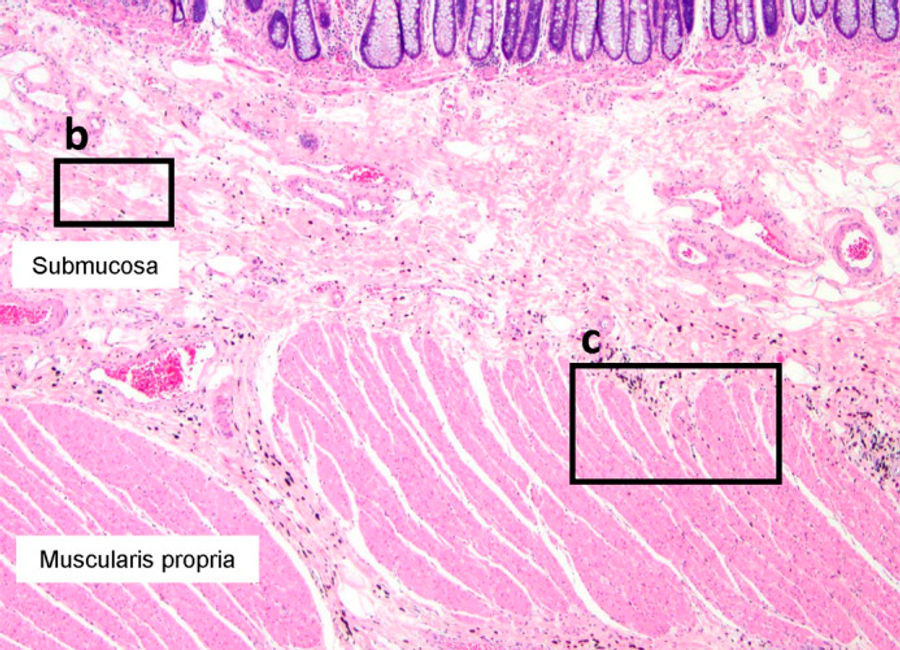
Dispersed tattoo ink reveals the continuity of the interstitium within and between organs — here, the colon — suggesting a body-wide communication network of fluid-filled spaces. Image: Cenaj et al., Communications Biology (2021), CC BY 4.0, via Peeples L., PNAS (2026).
A Seattle acupuncturist's reaction to the New York Times's coverage of the interstitium — and why the actual peer-reviewed science is more interesting than the magazine spread.
Last week, the New York Times Magazine published The Astounding Discovery That Could Link Eastern and Western Medicine — a heavily designed interactive feature about the interstitium, the fluid-filled tissue network mapped by NYU pathologist Neil Theise, and what it might mean for how acupuncture works.
That article is built on a more substantive March 2026 piece in the Proceedings of the National Academy of Sciences. The PNAS article opens with Min Chen, a Traditional Chinese Medicine practitioner who moved from Liaoning Province to Seattle two years ago. She told the reporter that her American patients ask different questions than her patients in China. They want the mechanism. They want the citation. They want to know why before they'll let her put a needle in.
She's right about that. I see it every week in my own treatment room in downtown Seattle. So here's what I want my patients to know about what the science is actually showing — not the magazine version, the peer-reviewed version.
Acupuncture works through more than one mechanism
That's the first thing to internalize, because the question “how does acupuncture work?” assumes there's one answer. There isn't. The PNAS review traces at least four pathways, and they almost certainly interact.
1. Local: needle, collagen, fibroblasts
When I rotate a needle, the surrounding collagen fibers wind around it like spaghetti on a fork. That's why patients often feel a dull, deep, slightly achy sensation when the point “grabs.” Chinese medicine calls that sensation deqi. Helene Langevin's lab at the NIH has spent twenty years documenting that this isn't just sensation — it's a mechanical signal. Fibroblasts in the surrounding connective tissue respond by activating, releasing cytokines, and triggering an immune response that extends several centimeters out from the needle.
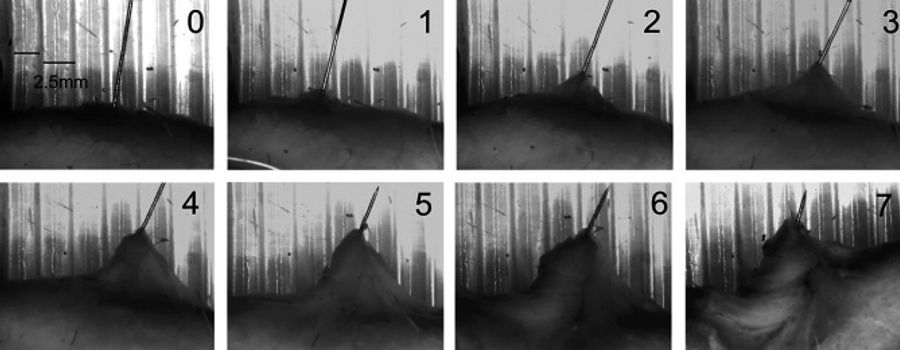
Acupuncture needle rotations create a connective tissue “whorl” in rat subcutaneous tissue, with the whorl growing as needle revolutions increase (0–7). Image: Langevin et al., reprinted in Peeples L., PNAS (2026).
In mouse tissue studies, that fibroblast response peaks at exactly two rotations of the needle (Langevin et al., 2006). Rotating back and forth produces a different response than rotating continuously in one direction (Langevin et al., 2007). The technique isn't decorative. It's dose-dependent. There are reasons we do it the way we do it.
2. Systemic: the interstitium as a communication network
This is the part the NYT piece is selling. Theise and colleagues' 2018 and 2021 papers mapped the interstitium — a body-wide network of fluid-filled spaces threaded between organs, blood vessels, and nerves — for the first time using imaging that captures living tissue. (Earlier histology missed it for over a century because the fluid collapses during slide fixation.)

In 2002, Langevin mapped acupuncture points onto serial cross-sections of the human arm and found that 80% of them fall on connective tissue planes (Langevin and Yandow, 2002). Then in 2021, Andrew Ahn's team at the Osher Center injected a fluorescent dye into Pericardium 6 on the inner forearm and watched it migrate, through interstitial spaces, to Pericardium 3 at the elbow (Li et al., 2021). The path the dye traveled matched the classical pericardium meridian.
That doesn't prove meridians are interstitial channels. It does mean we now have a candidate anatomy. Theise himself calls the prospect “tantalizing.” That's careful word choice from a working pathologist, and I'd encourage anyone writing about this to match his caution rather than overshoot it.
3. Neuroimmune: the vagal-adrenal axis
A 2021 paper in Nature identified the specific sensory neurons that electroacupuncture engages to trigger an anti-inflammatory response through the vagus nerve and the adrenal gland (Liu et al., 2021). This is the same nerve that bioelectronic medicine is currently targeting with implanted and external stimulators for rheumatoid arthritis, IBD, and heart disease.
The framing some researchers now use: implantable vagus nerve stimulators are essentially a modern, expensive, single-target version of what ear acupuncture has been doing since the 1970s. The US Army uses auricular acupuncture in deployed soldiers for pain, migraines, and stress. That's not fringe — that's the Department of Defense.
4. Central: the brain over time
Brain imaging studies show that regular acupuncture changes how the somatosensory cortex communicates with the regions that regulate pain, emotion, and stress (Harris, 2017). It's not just turning down the volume on today's pain signal. Over a course of treatment, the brain learns to process pain differently.
The sham acupuncture question
I want to address something head-on, because patients who've done their own reading eventually ask: doesn't the research show that “fake” acupuncture works just as well?
Some of it did, in the early days. About half of older trials found that needling at non-meridian “sham” points produced comparable benefit to needling at real points. That's a real finding. It's also incomplete.
When a real needle goes into real tissue — even at a non-classical point — you're still activating collagen, fibroblasts, sensory nerves, and the vagal-adrenal axis. Sham acupuncture isn't a placebo. It's a low dose of real acupuncture. Arya Nielsen, an acupuncturist and fellowship director at Mount Sinai, published a paper in September 2025 arguing that older Cochrane reviews underestimated acupuncture's efficacy for exactly this reason (Nielsen and Wieland, 2025). Funders have largely shifted toward comparing acupuncture to standard medical care instead.
In those comparisons, acupuncture holds up. A 2018 meta-analysis of more than 20,000 patients found that 85% of acupuncture's pain-relief benefit was still present at one year (Vickers et al., 2018). NSAIDs cannot claim that. A September 2025 trial in JAMA Network Open found acupuncture outperformed standard care for chronic low-back pain in older adults, with benefits lasting at twelve months (DeBar et al., 2025).
The more accurate question isn't does acupuncture beat placebo. It's does precise point selection and technique outperform random needling. We now have anatomical reasons to think it does.
What I see in the treatment room
A few things I notice often in my practice that the new research is starting to make sense of:
The points my hands find through palpation — tender, slightly tense, sometimes with a small palpable nodule — are often the points that produce the strongest clinical effect. EunMee Yang's research at the Osher Center suggests these tender spots, which tend to correspond to traditional acupoints, may be more therapeutically active than nearby non-tender areas (Yang et al., 2024). My hands knew that before her data did. Now I understand why.
Patients with chronic conditions often need a build phase before they hold the gains. That fits with what brain imaging shows about cortical reorganization — it takes time and repetition. Memberships aren't a sales tactic; they're how the mechanism actually works.
Electroacupuncture at low frequency (around 2 Hz) builds gradually and lasts. High frequency hits faster but fades. Alternating between the two often produces the most durable pain response, which is why I use it for patients who haven't responded fully to manual needling alone.
Ear points reliably calm a dysregulated nervous system in patients with anxiety, insomnia, or trauma history. The vagal-adrenal mechanism explains why a single auricular protocol can be useful across stress, addiction recovery, and inflammation — they share a circuit.
What's coming
The most interesting near-term development is the Topological Atlas and Repository for Acupoint research (TARA), an NIH-funded project building a searchable 3D MRI atlas of acupoints mapped to underlying anatomy, with AI integration and links to the clinical trial literature. When it's fully online, any clinician — or curious patient — will be able to click an acupoint and see exactly what's beneath it and what conditions it's been studied for.
Combined with the rapid growth of bioelectronic medicine, we're heading toward a decade where the line between “alternative” and “conventional” is going to get blurry. Vagus nerve stimulators are already FDA-approved devices. Auricular acupuncture targets the same nerve, costs a fraction, and has a few thousand years of clinical refinement behind it. Neil Theise put it best in the PNAS piece: we now have an anatomy that allows us to make sense of acupuncture in Western terms.
What this means if you're considering acupuncture
The question isn't whether acupuncture has a biological mechanism. It has several. The question is whether it's the right tool for what you're dealing with — and whether the person holding the needle is trained well enough to use it.
I'm careful not to overclaim. The research isn't finished. Some mechanisms are well documented, some are working hypotheses, and the meridian-as-interstitium connection is, in Theise's word, tantalizing rather than proven. What I can say is that the gap between what acupuncturists have been doing for two and a half millennia and what Western anatomy can now see is closing fast. And it's a more interesting story than any magazine spread.
If you're curious whether acupuncture might help with something you're dealing with — pain, anxiety, sleep, perimenopausal symptoms, GI issues, post-surgical recovery, fertility — I'd rather have a twenty-minute conversation with you about what's known and what's not than have you read another article. Book a consult. Bring your questions.
Want the visual version?
I’ve also put together a standalone walk-through of these four mechanisms — with annotated infographics, anchors for every glossary term, and the same citations — at goodmedizen.com/how-acupuncture-works. Same science, different format — a quick-reference page if you ever want to send a link to someone.
Glossary
Quick definitions for the terms used above, in alphabetical order.
Acupoint — A specific point on the body where acupuncture needles are inserted. Most acupoints fall along classical meridians; about 80% correspond to dense connective tissue planes, and many to areas of palpable tenderness.
Deqi — The dull, deep, slightly achy sensation that signals an acupuncture point has been properly engaged. Modern research interprets it as the mechanical response of collagen and fibroblasts in the surrounding connective tissue when the needle is rotated.
Electroacupuncture — Acupuncture in which a small electrical current is passed between two inserted needles. Different frequencies produce different effects: low frequency (around 2 Hz) builds gradually and lasts; high frequency hits faster but fades sooner.
Fascia — The continuous, body-wide network of connective tissue surrounding and threading through every muscle, organ, blood vessel, and nerve. Composed primarily of collagen embedded in a hyaluronic-acid-rich matrix.
Fibroblast — The main cell type in connective tissue. When a rotated acupuncture needle mechanically stresses surrounding collagen, fibroblasts activate and release signaling molecules that spread the response through the tissue.
Interstitium — A continuous, body-wide network of fluid-filled spaces threaded through connective tissue. Mapped by Theise and colleagues in 2018 and 2021 using imaging that captures living tissue. May correspond anatomically to the classical TCM meridian network.
Mechanotransduction — The process by which cells convert mechanical force, such as pressure or stretch, into biochemical signals. The leading hypothesis for how needle rotation translates into systemic physiological effects.
Meridian — In Traditional Chinese Medicine, a channel through which qi flows. Twelve primary meridians connect surface acupoints to internal organ systems. Recent anatomical research suggests meridians may correspond to interstitial pathways within the fascia.
Sham acupuncture — Needling at non-classical points, used as a control in clinical trials. Recent research argues sham acupuncture is not a true placebo because real needles in real tissue still activate fibroblasts, sensory nerves, and the vagal-adrenal reflex.
Somatosensory cortex — The region of the brain that processes touch, pressure, temperature, and pain. Brain imaging studies show regular acupuncture changes how this region communicates with the areas regulating emotion and stress.
Vagal-adrenal axis — The neuroimmune pathway by which electroacupuncture triggers anti-inflammatory effects: sensory nerves → vagus nerve → adrenal gland → release of anti-inflammatory compounds. Identified in a 2021 Nature paper by Liu et al.
References
DeBar, L. L., et al. (2025). Acupuncture for chronic low back pain in older adults: A randomized clinical trial. JAMA Network Open, 8.
Harris, R. E. (2017). Acupuncture “rewires” the brain… with lasting effects. Journal of Alternative and Complementary Medicine, 23.
Langevin, H. M., & Yandow, J. A. (2002). Relationship of acupuncture points and meridians to connective tissue planes. Anatomical Record, 269.
Langevin, H. M., et al. (2006). Subcutaneous tissue fibroblast cytoskeletal remodeling induced by acupuncture. Journal of Cellular Physiology, 207.
Langevin, H. M., et al. (2007). Connective tissue fibroblast response to acupuncture: Dose-dependent effect of bidirectional needle rotation. Journal of Alternative and Complementary Medicine, 13.
Li, T., et al. (2021). In vivo visualization of the pericardium meridian with fluorescent dyes. Evidence-Based Complementary and Alternative Medicine, 2021.
Liu, S., et al. (2021). A neuroanatomical basis for electroacupuncture to drive the vagal-adrenal axis. Nature, 598.
Nielsen, A., & Wieland, L. S. (2025). Cochrane reviews of acupuncture are dated, do not account for the specific effects of sham controls and likely underestimate the efficacy of acupuncture therapy. Integrative Medicine Research, 14.
Peeples, L. (2026). What’s the science behind acupuncture? Proceedings of the National Academy of Sciences, 123(10).
Theise, N., et al. (2018). Structure and distribution of an unrecognized interstitium in human tissues. Scientific Reports, 8.
Vickers, A. J., et al. (2018). Acupuncture for chronic pain: Update of an individual patient data meta-analysis. Journal of Pain, 19.
Yang, E., et al. (2024). Acupoint sensitivity in health and disease: A systematic review. Journal of Integrative and Complementary Medicine, 30.


Comments