.png)
How Functional Medicine and Traditional Chinese Medicine Work Together
Updated: Oct 12
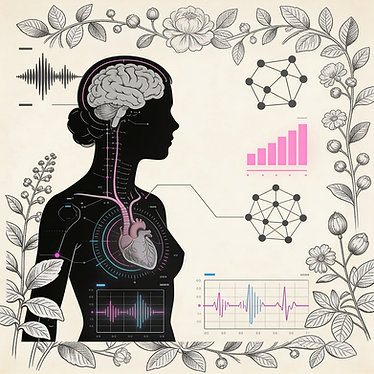
Functional medicine and Traditional Chinese Medicine (TCM) integrate through a shared clinical question — why is this happening? — answered in two languages. Functional medicine maps the biochemistry using labs, history, and nutrition. TCM maps the pattern using pulse, tongue, and presentation. In a combined practice, one practitioner runs both assessments in the same visit and builds a single plan from them.
Written by Courtney M. Zeller, AEMP, L.Ac., MS — licensed acupuncturist and functional medicine practitioner, GoodMedizen, downtown Seattle. Reviewed August 2026.
The short version
Functional Medicine | Traditional Chinese Medicine | |
Core question | Which systems are dysregulated, and what is driving it? | What pattern is this person presenting, and what does it need? |
What it looks at | Digestion, hormones, immune signaling, inflammation, detoxification, nutrient status, stress physiology | Yin/yang, qi and blood, the organ systems, cold/heat, deficiency/excess, interior/exterior |
How it assesses | Timeline intake, functional labs — stool, hormone, organic acid, micronutrient, thyroid panels | Pulse quality, tongue body and coat, palpation, symptom patterning, history |
Primary tools | Targeted nutrition, botanicals, nutrients, sleep and stress work, sequencing | Acupuncture, Chinese herbal formulas, dietary therapy, moxibustion, qigong, cupping |
Time horizon | Reassess on lab intervals — usually 8 to 12 weeks | Reassess every visit; the pulse and tongue change faster than the labs |
Regulatory home | Not a licensed profession; a model of care practiced by licensed clinicians | A licensed profession in Washington State (L.Ac.) with a national board exam (NCCAOM) |
The last row matters more than people expect. Functional medicine is a framework, not a license. Anyone can claim it. Traditional Chinese Medicine, practiced legally, requires a master's degree, a national board certification, and a state license. When one person holds both — the license and the functional training — the two systems stop being a referral relationship and start being a single clinical process.
Where the two systems already agree
Three overlaps do most of the work.
They both refuse to stop at the symptom. A headache is a starting point in each system, never a diagnosis. Functional medicine asks what is upstream: blood sugar, cervical mechanics, estrogen clearance, sleep architecture. TCM asks the same thing in different vocabulary: is this Liver yang rising, is it blood deficiency, is it dampness obstructing the head. Neither system is satisfied by naming the pain.
They both treat the individual, not the diagnosis. Ten patients arrive with the same label and leave with ten plans. Functional medicine gets there through the timeline and the labs. TCM gets there through pattern differentiation — the formal process of sorting which of several possible patterns a person is actually presenting. Two patients with identical migraine diagnoses can receive completely different formulas, and that is the system working correctly.
They both start with food, sleep, and stress. Functional medicine calls it food-first. TCM has had dietary therapy for roughly two thousand years, sorted by thermal nature and by the organ system a food supports. The overlap here is close enough that patients often cannot tell which system a given recommendation came from — which is fine, because the recommendation is the same either way.
Where they genuinely differ
Pretending these systems are identical does both of them a disservice.
Functional medicine is measurable in ways TCM is not. A stool panel returns a number. A pulse returns a trained clinician's read. Both are useful; only one can be handed to an endocrinologist. When something needs to be documented, quantified, or tracked across providers, the functional side carries the case.
TCM is responsive in ways lab work is not. Labs describe where a body was on the morning of the draw. The pulse describes where it is right now. For conditions that shift week to week — sleep, digestion, cycle symptoms, pain that moves — pattern assessment catches changes that a quarterly panel will miss entirely.
Their explanatory models do not reduce to one another. Qi is not ATP. The TCM Spleen is not the anatomical spleen, and saying so out loud is one of the first things an honest practitioner should tell a patient. The systems are translatable at the level of clinical decisions and not at the level of mechanism. Anyone selling a tidy one-to-one mapping is overselling.
This is not a fringe position. A review in Healthcare framing the integration problem put it as needing "a rational communicable theory, scientific proof of efficacy and safety, and quality control measures" before TCM can sit comfortably inside Western health systems (Matos et al., 2021). The World Health Organization went further and published a formal terminology standard for exactly this reason — a shared vocabulary has to exist before two systems can be said to agree on anything (WHO International Standard Terminologies on Traditional Medicine in the Western Pacific Region).
How integration works in practice: the five-step process
This is the workflow used at GoodMedizen. It is one clinic's approach, not a universal standard.
1. One intake, two lenses.
The intake collects a functional medicine timeline — when symptoms started, what else was happening that year, medications, surgeries, diet, sleep, stress load, family history — and a TCM assessment in the same sitting: pulse, tongue, palpation, thermal preferences, sweat, thirst, digestion, sleep quality, cycle detail. Nothing is collected twice. The two assessments ask different questions about the same fifty minutes.
2. Two working hypotheses, written side by side.
The functional hypothesis reads something like post-antibiotic dysbiosis with secondary bile insufficiency and low ferritin. The TCM hypothesis reads something like Spleen qi deficiency with damp accumulation and blood deficiency. Those are the same patient. They are not translations of each other, and they do not need to be — they need to point at the same intervention.
3. Labs confirm the biological piece; the pattern shapes the delivery.
Labs answer is there a measurable contributor, and how big is it. Pattern differentiation answers how does this particular person need to be treated. A patient with confirmed low stomach acid who presents with a cold, deficient pattern receives warming support and a slow build. The same lab finding in a hot, excess presentation gets a different formula and a different pace. Same number, different plan.
4. One plan, sequenced.
The failure mode in integrative care is the plan that lists fourteen things. The sequencing rule at GoodMedizen is Exits-First — calm the system, replenish what is depleted, open the routes of elimination, and only then push anything out, followed by reassessment. Acupuncture sessions typically run alongside the nutritional work rather than after it, because the treatments are doing different jobs: one is regulating the nervous system and pain signaling week to week, the other is changing the substrate over months.
5. Reassess on two clocks.
Pattern assessment happens every visit and adjusts the formula and the point selection. Lab reassessment happens on the interval the specific test warrants — often 8 to 12 weeks. Running both clocks catches the case that feels better while the numbers stall, and the case where the numbers move while the person still feels terrible. Both happen. Both mean something.
What the evidence supports
Careful language matters here, so here is where the evidence actually sits.
Acupuncture for chronic pain has strong support. An individual patient data meta-analysis of 39 trials and 20,827 patients found acupuncture superior to both sham and no-acupuncture control for musculoskeletal pain, osteoarthritis, chronic headache, and shoulder pain, with effects persisting at one year with roughly a 15% decrease in treatment effect. (Vickers et al., The Journal of Pain, 2018)
The functional medicine model has one substantial outcomes study. A retrospective cohort of 7,252 patients comparing the Cleveland Clinic Center for Functional Medicine with propensity-matched primary care patients found significantly larger improvements in PROMIS Global Physical Health scores at six months. The authors called for prospective studies to confirm the findings. (Beidelschies et al., JAMA Network Open, 2019)
The integration itself has not been studied as a model. No trial has compared combined functional medicine and TCM care against either system alone. What exists is evidence for the components and clinical experience with the combination. Any practitioner claiming the integrated model is proven superior is ahead of the data.
Federal health information on TCM is available through the National Center for Complementary and Integrative Health at the National Institutes of Health. (NCCIH: Traditional Chinese Medicine — What You Need To Know)
The safety layer: herbs and prescriptions
Herbal medicine is where integration carries real risk, and it deserves its own paragraph rather than a footnote.
Chinese herbs are pharmacologically active. Several commonly used herbs — including Danshen (Salvia miltiorrhiza), Huangqi (Astragalus membranaceus), and Chaihu (Bupleurum chinense) — have documented effects on cytochrome P450 enzymes, the liver and intestinal enzyme family responsible for roughly half of all drug elimination. Inducing or inhibiting CYP3A4 can change how much of a prescription drug reaches circulation. (Hsieh & Huang, Journal of the Chinese Medical Association, 2026)
The practical rules that follow from this:
Every prescription, over-the-counter drug, and supplement gets listed before a formula is written. Not "the important ones" — the whole list.
Narrow-therapeutic-index drugs — warfarin, certain antiepileptics, immunosuppressants, thyroid replacement, some oncology agents — raise the bar. Some combinations are workable with timing separation and monitoring; some are not worth attempting.
Herbs come from suppliers with third-party heavy metal and adulterant testing, with documentation available on request.
Prescribing physicians get told what a patient is taking. Coordination is the safety mechanism, and it works only when both sides have the list.
If a practitioner does not ask for the full medication list before writing a formula, that is a reason to find a different practitioner.
Who a combined approach fits — and who it does not
A good fit:
Chronic symptoms with normal standard labs, where the workup keeps coming back clean and the person still feels unwell
Digestive complaints that have outlasted a round or two of treatment
Hormonal and cycle symptoms — the assessment overlap here is unusually strong
Long-COVID-style multi-system presentations with fatigue, cognitive symptoms, and dysautonomia
Pain conditions where the nervous system has become part of the problem
Patients who want lab evidence and hands-on treatment from the same person, rather than assembling a care team themselves
Not a good fit, or not yet:
Acute presentations needing emergency evaluation — chest pain, stroke symptoms, acute abdomen, severe infection. Integrative care is not a triage system - go to the ER.
Unexplained weight loss, new neurological deficits, or bleeding that has not been worked up conventionally. Those get a conventional workup first, Always.
Patients wanting a single test that explains everything. That test does not exist in either system - functional medicine will likely add more variables, not less - this is a journey not a quick fix.
What a first visit at GoodMedizen involves
Ninety minutes. The timeline intake and the TCM assessment happen in the same appointment. Acupuncture treatment usually begins that day, since there is rarely a reason to wait. Which lab panels are worth considering gets discussed at the end of the visit, once there is enough information to know which ones would change the plan — running a standard battery on every patient is how integrative care gets expensive without getting more accurate.
Results reviews are their own appointment. The lab report is read together, the functional and pattern hypotheses are reconciled against what came back, and the plan is sequenced from there.
To ask whether this approach fits your situation, text us at (206) 402-3813.
FAQ
Is functional medicine the same as integrative medicine?
No. Functional medicine is a specific systems-based model that maps how body systems interact to produce symptoms. Integrative medicine is a broader umbrella describing the combination of conventional and complementary care. A practice can be integrative without using the functional medicine model at all.
Do I have to believe in qi for acupuncture to help?
No. Acupuncture's measured effects on chronic pain do not depend on the patient's belief in the explanatory model. The traditional framework is how points are selected and how a case is organized; the clinical result does not require the patient to adopt it.
Can Chinese herbs be taken with prescription medications?
Sometimes, with review. Several common Chinese herbs affect cytochrome P450 enzymes and can change drug levels. A complete medication list is required before any formula is written, and certain combinations — particularly with narrow-therapeutic-index drugs like warfarin — are avoided rather than managed.
How is pattern differentiation different from a diagnosis?
A diagnosis names a disease; a pattern names the state a particular person is in. Two patients with the same diagnosis can present with opposite patterns — one cold and depleted, one hot and congested — and require different formulas. Pattern differentiation is what makes Chinese medicine individualized rather than protocol-driven.
Does insurance cover this?
Acupuncture is covered by many Washington State plans. Functional medicine consultations and functional lab testing are usually not, and are billed directly or paid to the laboratory. Coverage should be verified before the first visit.
How long before something changes?
Pain and sleep often respond within two to six acupuncture sessions. Digestive and hormonal work follows the lab reassessment interval, generally 8 to 12 weeks. Anyone promising a specific timeline before seeing your case is guessing.
Do I need to stop seeing my primary care provider?
No!! A combined approach is designed to run alongside conventional care, not replace it. Prescribing decisions stay with the prescriber, and coordination — sending the supplement and herb list to the other providers on the case — is part of doing this safely.
What credentials should I look for?
For the Chinese Medicine side: a state license (L.Ac. or the state's equivalent, in Washington State it is AEMP - Acupuncture & Eastern Medicine Practitioner) and NCCAOM board certification. For the functional medicine side: ask what the training was and who granted it, since functional medicine is not a licensed profession and the term is unregulated.
References and further reading
These are the primary sources behind this page, listed so you can read them yourself rather than take a clinic's word for any of it.
Cleveland Clinic Center for Functional Medicine — About the functional medicine model
National Center for Complementary and Integrative Health, NIH — Traditional Chinese Medicine: What You Need To Know and the NCCIH Traditional Chinese Medicine fact sheet (PDF)
World Health Organization — International Standard Terminologies on Traditional Medicine in the Western Pacific Region (PDF)
Matos LC, Machado JP, Monteiro FJ, Greten HJ. Understanding Traditional Chinese Medicine Therapeutics: An Overview of the Basics and Clinical Applications. Healthcare. 2021;9(3):257. DOI
Vickers AJ, et al. Acupuncture for Chronic Pain: Update of an Individual Patient Data Meta-Analysis. The Journal of Pain. 2018;19(5):455–474. DOI
Beidelschies M, et al. Association of the Functional Medicine Model of Care With Patient-Reported Health-Related Quality-of-Life Outcomes. JAMA Network Open. 2019;2(10):e1914017. DOI
Hsieh YH, Huang ST. Interactions between cytochrome P450 enzymes and traditional Chinese herbs: A comprehensive review. Journal of the Chinese Medical Association. 2026. DOI
National Health Commission of the People's Republic of China — Traditional Chinese Medicine in China
Washington State Legislature — RCW 18.06.010, Acupuncture and Eastern Medicine definitions and scope
About the author
Courtney M. Zeller, AEMP, L.Ac., MS is the owner and primary practitioner at GoodMedizen, an integrative acupuncture and functional medicine clinic in downtown Seattle. She holds a Master of Science in Acupuncture from Bastyr University, has practiced acupuncture since 2011, and holds a QSI Detoxification Certification. NPI 1780937391.
GoodMedizen · 509 Olive Way, Suite 1401, Seattle, WA 98101 · goodmedizen.com · (206) 402-3813
This page is educational. It is not medical advice and is not a substitute for care from a qualified provider who knows your history. Nothing here is intended to diagnose, treat, cure, or prevent any disease.
Comments